Acetone → 3,4-bis(p-toluyloxy)phenyl N-(tert-butyl)aminomethyl ketone hydrochloride
Reaction equation
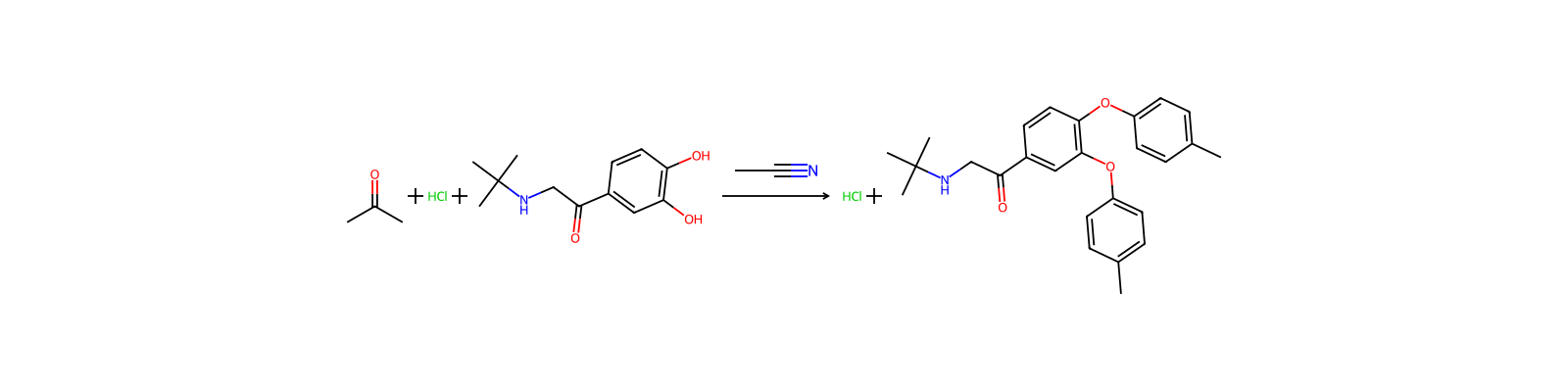
[CH3:1][C:2]([CH3:4])=O.[ClH:5].[C:6]([NH:10][CH2:11][C:12]([C:14]1[CH:19]=[CH:18][C:17]([OH:20])=[C:16]([OH:21])[CH:15]=1)=[O:13])([CH3:9])([CH3:8])[CH3:7]>C(#N)C>[ClH:5].[C:6]([NH:10][CH2:11][C:12]([C:14]1[CH:19]=[CH:18][C:17]([O:20][C:2]2[CH:4]=[CH:8][C:6]([CH3:9])=[CH:7][CH:1]=2)=[C:16]([O:21][C:17]2[CH:18]=[CH:19][C:14]([CH3:12])=[CH:15][CH:16]=2)[CH:15]=1)=[O:13])([CH3:9])([CH3:7])[CH3:8]Participants
4




Procedure
The process of Example 1 was repeated substituting acetone for the acetonitrile as solvent. Starting with 26 g of 3,4-dihydroxyphenyl N-(tert-butyl)aminomethyl ketone hydrochloride there was obtained 33 g of 3,4-bis-(p-toluyloxy)phenyl N-(tert-butyl)aminomethyl ketone hydrochloride (64% yield) containing only a trace of tributylamine hydrochloride.
Sources & evidence
- ORD record
- ord-d46a8f2707ab496ebc72f32a0fd139ff
- Source dataset
- uspto-grants-1986_09
- Patent number
- US04614830
Reaction notes
Loading…