Dodecasodium;tetraborate → Sodium Tetraborate
Reaction equation

[B:1]([O-:4])([O-:3])[O-:2].[B:5]([O-:8])([O-:7])[O-:6].[B:9]([O-:12])([O-])[O-].[B:13]([O-])([O-])[O-].[Na+:17].[Na+].[Na+].[Na+].[Na+].[Na+].[Na+].[Na+].[Na+].[Na+].[Na+].[Na+]>O>[B:1]1([O-:4])[O:3][B:13]2[O:12][B:9]([O:6][B:5]([O-:8])[O:7]2)[O:2]1.[Na+:17].[Na+:17]Participants
Reactant 1

Product 1
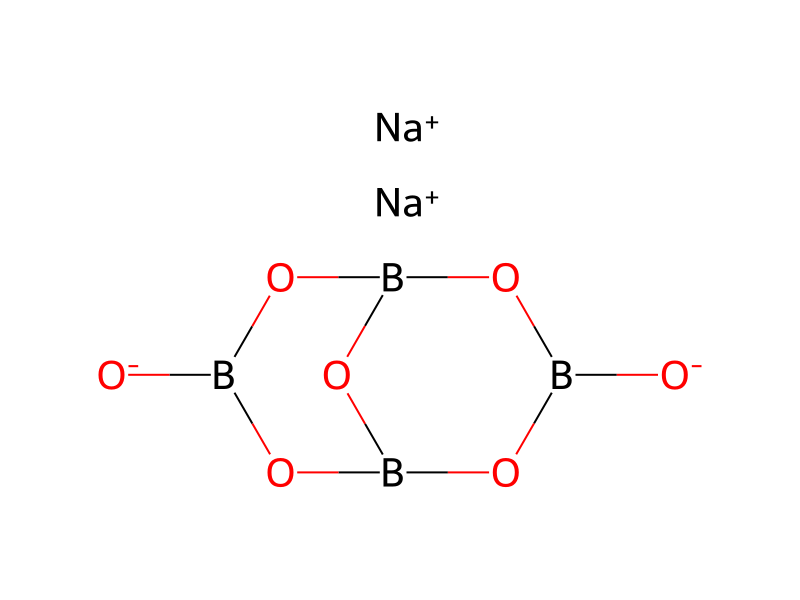
Reagents, catalysts & solvents 1

Conditions
- Temperature
- 1100 °C
Procedure
Sodium tetraborate (Na2B4O7.10H2O), analyzed reagent was dried overnight at 150° C, mixed with the appropriate quantity of dopant ions and homogenized in an electric homogenizer (vibrator) during 10 minutes. The material was then transferred to a platinum crucible and heated at 1100° C for at least 30 minutes, until a clear transparent solution was obtained. The glass matrix loses water and the composition of the matrix is after the heating 35(Na2O).65(B2O3). A drop of the hot melt was allowed to fall directly onto a clean white glazed ceramic surface, into the center of a space ring of 1 mm thickness, and pressed with a second ceramic tile to produce a glass disk of 1 mm thickness and an approximate diameter of 12 mm. The glass is transparent in the ultraviolet and in the visible part of the spectrum.
Workup
- customwas dried overnight at 150° C
- additionmixed with the appropriate quantity of dopant ions
- customwas obtained
- customto produce a glass disk of 1 mm thickness
Sources & evidence
- ORD record
- ord-50d2ed7d23df46e19e1dda7dc1f6c787
- Source dataset
- uspto-grants-1978_12
- Patent number
- US04128411
Reaction notes
Loading…