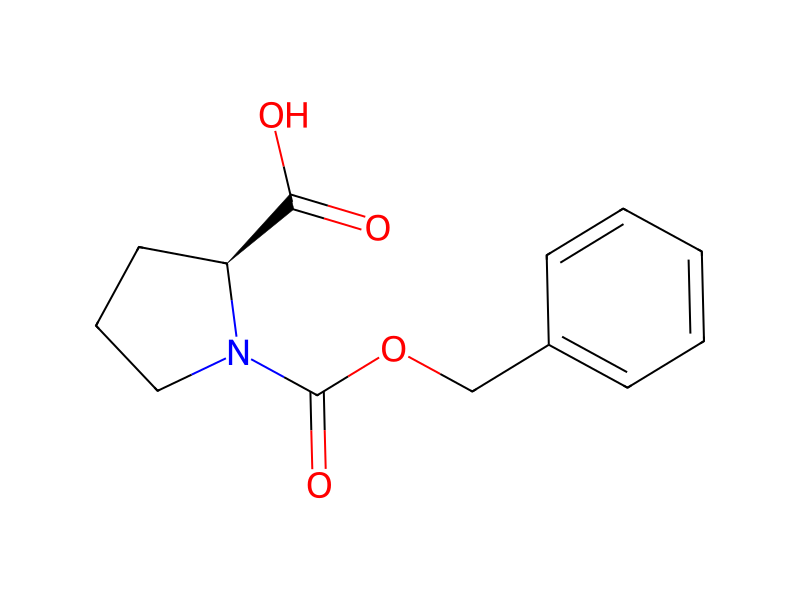
Benzyloxycarbonyl-L-proline → 2-(1,1-Dimethylethyl) 1-(phenylmethyl) (2S)-1,2-pyrrolidinedicarboxylate
Reaction equation

[CH2:1]([O:8][C:9]([N:11]1[CH2:18][CH2:17][CH2:16][C@H:12]1[C:13]([OH:15])=[O:14])=[O:10])[C:2]1[CH:7]=[CH:6][CH:5]=[CH:4][CH:3]=1>ClCCl.CC(=C)C.S(=O)(=O)(O)O>[C:2]([O:14][C:13](=[O:15])[C@@H:12]1[CH2:16][CH2:17][CH2:18][N:11]1[C:9]([O:8][CH2:1][C:2]1[CH:3]=[CH:4][CH:5]=[CH:6][CH:7]=1)=[O:10])([CH3:7])([CH3:3])[CH3:1]Participants
5




Procedure
The benzyloxycarbonyl-L-proline thus obtained (180 g.) is dissolved in a mixture of dichloromethane (300 ml.), liquid isobutylene (800 ml.) and concentrated sulfuric acid (7.2 ml.). The solution is shaken in a pressure bottle for 72 hours. The pressure is released, the isobutylene is allowed to evaporate and the solution is washed with 5% sodium carbonate, water, dried over magnesium sulfate and concentrated to dryness in vacuo, to obtain benyloxycarbonyl-L-proline tert.butyl ester, yield 205 g.
Workup
- customto evaporate
- washthe solution is washed with 5% sodium carbonate, water
- dry with materialdried over magnesium sulfate
- concentrationconcentrated to dryness in vacuo
Sources & evidence
- ORD record
- ord-f9ebc023c0c940a697d43746e730fb8c
- Source dataset
- uspto-grants-1978_12
- Patent number
- US04128653
Reaction notes
Loading…