Phosphorus oxychloride → 4-Chloroquinazoline
Reaction equation

O[C:2]1[C:11]2[C:6](=[CH:7][CH:8]=[CH:9][CH:10]=2)[N:5]=[CH:4][N:3]=1.O=P(Cl)(Cl)[Cl:14]>>[Cl:14][C:2]1[C:11]2[C:6](=[CH:7][CH:8]=[CH:9][CH:10]=2)[N:5]=[CH:4][N:3]=1Participants
3


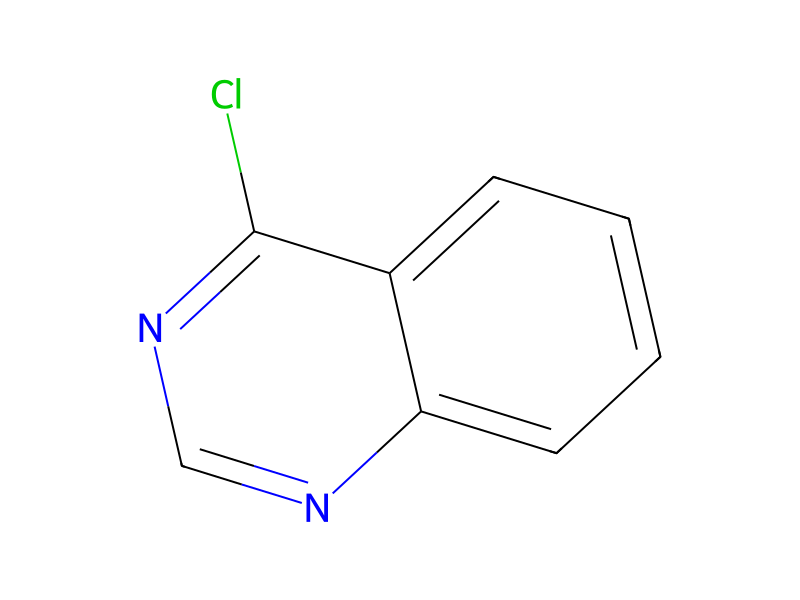
Conditions
- Temperature
- 140 °C
Procedure
A mixture of 4-hydroxyquinazoline (2.56 g, 17.5 mmol) and POCl3 (8.0 mL, 88 mmol) was stirred at 140° C. (oil bath) for 10 min. The homogeneous light amber solution was then allowed to cool to rt before concentrating under reduced pressure at 70° C. The translucent residue was dissolved in DCM (25 mL), and the homogeneous yellow solution was partitioned with ice and 1 M NaHCO3 to pH ˜6 (paper) (˜20 mL aq layer). The organic layer was dried twice (Na2SO4), filtered through a 0.22 micron filter, and concentrated under reduced pressure (bath <40° C.) to provide the title compound as a yellow solid (2.53 g, 88%). 1H-NMR (300 MHz, CDCl3) δ 9.07 (s, 1H), 8.30 (ddd, 1H), 8.11 (m, 1H), 8.00 (m, 1H), 7.77 (m, 1H).
Workup
- temperatureto cool to rt
- concentrationbefore concentrating under reduced pressure at 70° C
- dissolutionThe translucent residue was dissolved in DCM (25 mL)
- customthe homogeneous yellow solution was partitioned with ice and 1 M NaHCO3 to pH ˜6 (paper) (˜20 mL aq layer)
- dry with materialThe organic layer was dried twice (Na2SO4)
- filtrationfiltered through a 0.22 micron
- filtrationfilter
- concentrationconcentrated under reduced pressure (bath <40° C.)
Sources & evidence
- ORD record
- ord-e99d6cc38e3244d0a799690189541de2
- Source dataset
- uspto-grants-2011_12
- Patent number
- US08071768B2
Reaction notes
Loading…