1,3-Dibromo-5,5-dimethylhydantoin → 1-Bromo-3-(bromomethyl)-5-methylbenzene
Reaction equation

[Br:1][C:2]1[CH:7]=[C:6]([CH3:8])[CH:5]=[C:4]([CH3:9])[CH:3]=1.[Br:10]N1C(C)(C)C(=O)N(Br)C1=O>C(Cl)(Cl)(Cl)Cl.C(OOC(=O)C1C=CC=CC=1)(=O)C1C=CC=CC=1>[Br:1][C:2]1[CH:7]=[C:6]([CH3:8])[CH:5]=[C:4]([CH2:9][Br:10])[CH:3]=1Participants
5

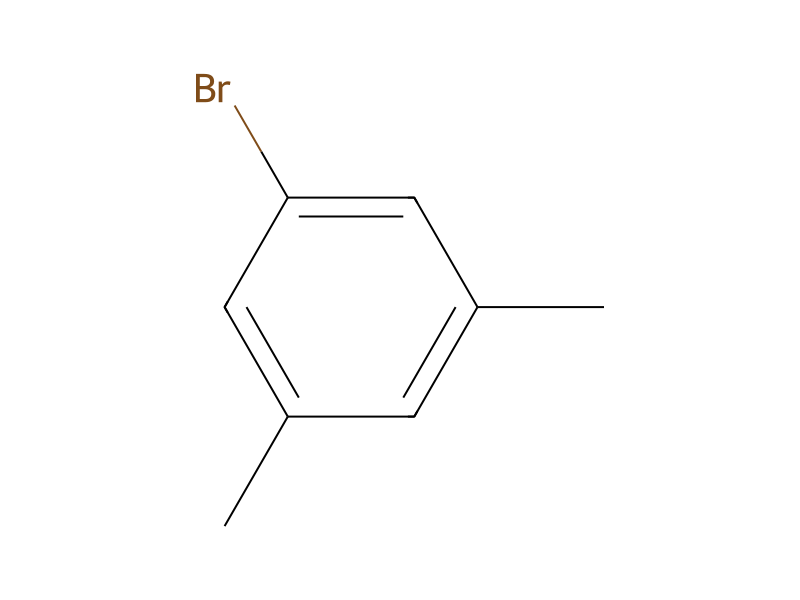



Procedure
To a solution of 1-bromo-3,5-dimethylbenzene (25.0 g, 135.0 mmol) in CCl4 (150 mL), was added 1,3-dibromo-5,5-dimethylimidazolidine-2,4-dione (14.5 g, 54.0 mmol) and dibenzoyl peroxide (BPO) (0.2 g) and the mixture was refluxed for 7 h. After the reaction mixture was cooled to room temperature, the precipitate was filtered out using Celite, and then the solid was rinsed two times with pentane (50 mL). The combined filtrates were washed with water (50 mL), followed by saturated sodium bicarbonate (50 mL) and sodium thiosulfate (50 mL×2). The organic layer was dried over anhydrous sodium sulfate. Evaporation of the solvent afforded the compound 1-bromo-3-(bromomethyl)-5-methylbenzene (35.6 g, 99%).
Workup
- temperaturethe mixture was refluxed for 7 h
- filtrationthe precipitate was filtered out
- washthe solid was rinsed two times with pentane (50 mL)
- washThe combined filtrates were washed with water (50 mL)
- dry with materialThe organic layer was dried over anhydrous sodium sulfate
- customEvaporation of the solvent
Sources & evidence
- ORD record
- ord-0cc5300d63a64ca49f7f488a681e8c43
- Source dataset
- uspto-grants-2011_12
- Patent number
- US08071588B2
Reaction notes
Loading…