
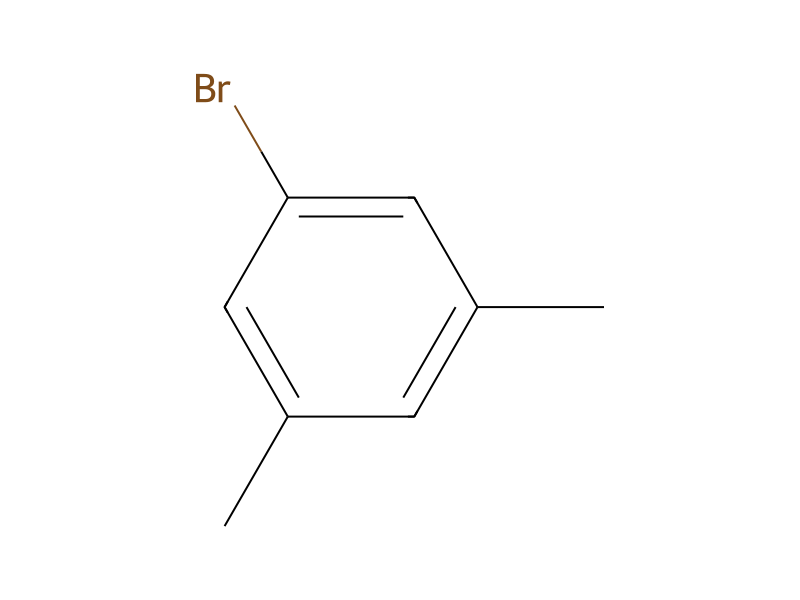
Basic information
- Standard SMILES
Cc1cc(C)cc(Br)c1- InChIKey
LMFRTSBQRLSJHC-UHFFFAOYSA-N- Molecular formula
- C8H9Br
- Average molar mass
- 185.06 g/mol
- Monoisotopic mass
- 183.98876239
Names & identifiers
- Preferred name
- Benzene, 1-bromo-3,5-dimethyl-
- IUPAC
- 1-bromo-3,5-dimethylbenzene
- English name
- 5-Bromo-m-xylene
- Molecular formula
- C8H9Br
- Molecular weight
- 185.06
Names & synonyms
5-Bromo-m-xylene556-96-7Benzene, 1-bromo-3,5-dimethyl-DTXSID00204142RefChem:562408DTXCID00126633629-686-51-Bromo-3,5-dimethylbenzene3,5-Dimethylbromobenzene1-bromo-3,5-dimethyl-benzenem-Xylene, 5-bromo-5-BROMO-META-XYLENE
Show more names
5-Bromo-1,3-xylene5-Bromo-m-xyL5-BROMOMETAXYLENE3,5-Xylyl bromide5-Bromo-m-xylene>5-Bromo-m-xylene,98%
MFCD000000871,3-Dimethyl-5-bromobenzeneSCHEMBL2497691-Bromo-3,5-dimethylbenzene, 97%AC-9668EN300-238241-bromo-3 , 5-dimethylbenzene5 -bromo-m-xylene
Database identifiers
- CAS
556-96-7- PubChem CID
- 136357
- DTXSID
DTXSID00204142- EC Number
- 629-686-5
- Nikkaji
- J31.755A
Properties
Computed structural properties
- XLogP
- 3.4
- Topological polar surface area
- 0 Ų
- Hydrogen bond donors
- 0
- Hydrogen bond acceptors
- 0
- Rotatable bonds
- 0
- Heavy atoms
- 9
- Formal charge
- 0
- Complexity
- 80.6
Experimental & physicochemical properties
SpringerMaterials PropertiesOptical coefficient
Physicochemical properties
- Melting point
- -20.49 °C · -20.49°C (estimate)
- Boiling point
- 202 · 202-204 °C(lit.)
- Density
- 1.362 g/mL · 1.362 g/mL at 25 °C(lit.)
- refractive index
- 20 · n20/D 1.549(lit.)
- Flash point
- 189 °F · 189 °F
- storage temp.
- Sealed in dry,Room Temperature
- solubility
- Miscible with tetrahydrofuran.
- form
- Liquid
- Specific Gravity
- 1.362 · 1.362
- color
- Clear colorless to light yellow
- BRN
- 1926375 · 1926375
- InChI
- InChI=1S/C8H9Br/c1-6-3-7(2)5-8(9)4-6/h3-5H,1-2H3
- InChIKey
- LMFRTSBQRLSJHC-UHFFFAOYSA-N
- SMILES
- C1(Br)=CC(C)=CC(C)=C1
- CAS DataBase Reference
- 556 · 556-96-7(CAS DataBase Reference)
- NIST Chemistry Reference
- 1 · Benzene, 1-bromo-3,5-dimethyl-(556-96-7)
- UNSPSC Code
- 12352100 · 12352100
- NACRES
- 22 · NA.22
- Symbol(GHS)
- 7 · GHS07
- Signal word
- Warning
- Hazard statements
- 315 · H315-H319
- Precautionary statements
- 264 · P264-P280-P302+P352-P305+P351+P338-P332+P313-P337+P313
- Hazard Codes
- Xi
- Risk Statements
- 36 · 36/37/38-22
- Safety Statements
- 26 · 26-36/37/39-37/39
- WGK Germany
- 3 · 3
- Hazard Note
- Irritant
- HS Code
- 29036990 · 29036990
Safety & regulation
GHS classification
GHS Classification
Warning
H315 (98.7%): Causes skin irritation [Warning Skin corrosion/irritation]
P261, P264, P264+P265, P271, P280, P302+P352, P304+P340, P305+P351+P338, P319, P321, P332+P317, P337+P317, P362+P364, P403+P233, P405, and P501 (click each P-code to see the statement)
Aggregated GHS information provided per 78 reports by companies from 9 notifications to the ECHA C&L Inventory. Each notification may be associated with multiple companies.
Hazard information
Hazard Classes and CategoriesSkin Irrit. 2 (98.7%)
Safety data
- wgk
- 3
- hs_code
- 29036990
- risk_code
- 36/37/38-22
- Signal word
- Warning
- Symbol(GHS)
- GHS07
- hazard_code
- Xi
- hazard_note
- Irritant
- safety_code
- 26-36/37/39-37/39
- Hazard statements
- H315-H319
- Precautionary statements
- P264-P280-P302+P352-P305+P351+P338-P332+P313-P337+P313
Chemistry & industry
Applications
Uses5-Bromo-m-xylene has been used in the synthesis of substituted 2,2′-bis(diphenylphosphanylmethyl)-1,1′-binaphthyl derivatives.
Uses5-Bromo-m-xylene is used in the preparation of substituted 2,2'-bis(diphenylphosphanylmethyl)-1,1'-binaphthyl derivatives. It is also used to prepare o-tolyl-3,5-xylyl ether by reacting with o-cresol. Further, it is an organic building block used in the synthesis of various chemicals as well as in the preparation of tri-o-tolylphosphine.
Uses1-Bromo-3,5-dimethylbenzene has been used in the synthesis of substituted 2,2′-bis(diphenylphosphanylmethyl)-1,1′-binaphthyl derivatives.
General DescriptionPalladium catalyzed carbon-oxygen coupling of 1-bromo-3,5-dimethylbenzene and o-cresol to potassium hydroxide to produce o-tolyl-3,5-xylyl ether has been reported.
Upstream & downstream products
Upstream raw materials
Downstream products
Suppliers50 total
国药集团化学试剂有限公司86-21-63210123 · [email protected]
杭州创引化工科技有限公司0571-87086220 13516718938 · [email protected]
梯希爱(上海)化成工业发展有限公司021-67121386 · [email protected]
衢州润东化工有限公司0570-8789886 18892685668 · [email protected]
上海阿拉丁生化科技股份有限公司400-6206333 13167063860 · [email protected]
常熟市海天医药原料有限公司13913622609
韶远科技(上海)有限公司021-50795510 4000665055 · [email protected]
常州思丹德化工有限公司0519-85607885 13776800733 · [email protected]
科瑞迪化学400-821-5857 021-64326257 · [email protected]
武汉捷又顺化工科技有限公司18062118104; 18062118104
上海迈瑞尔生化科技有限公司4006356688 18621169109 · [email protected]
阿法埃莎(中国)化学有限公司400-6106006 · [email protected]
上海德默医药科技有限公司400-021-7337 2355568890 · [email protected]
安耐吉化学&3A(安徽泽升科技股份有限公司)400-0056266 · [email protected]
武汉凯威斯科技有限公司86-027-67849912 · [email protected]
上海速博化学科技有限公司21-54820552 17702105771
上海瀚鸿科技股份有限公司021-54306202 13764082696 · [email protected]
上海景颜化工科技有限公司13817811078 · [email protected]
苏州莱克施德药业有限公司0512-63970158-603 18018108880 · [email protected]
上海隆盛化工有限公司58099637 13585536065 · [email protected]
杭州东帆化学有限公司86-0571-85151182
山东西亚化学有限公司13355009207 13355009207 · [email protected]
玛雅试剂+86 (573) 82222445 (0)18006601000 452520369 · [email protected]
四川库利南科技有限公司400-1166-196 18981987031 · [email protected]
常州四渡化工有限公司0519-81291281 18015082300
天津希恩思生化科技有限公司400 638 7771 · [email protected]
南京维奥化工有限公司Please Send Email 18652950785 · [email protected]
同创医药(苏州)有限公司0512-63263366 18912765016 · [email protected]
常州创视电子科技有限公司+86 (519) 8829-2061 · [email protected]
河南多贝化工有限公司0370-2785118 17550508557 · [email protected]
北京泰亚杰科技有限公司021-33690831-8001 13552411790;18616022633 · [email protected]
上海思域化工科技有限公司86-21-34053660 · [email protected]
赛默飞世尔科技(中国)有限公司800-810-5118 · [email protected]
北京伊诺凯科技有限公司400-810-7969 010-59572699 · [email protected]
江苏艾康生物医药研发有限公司025-66113011 13913916777 · [email protected]
TCI AMERICA800-4238616 · [email protected]
TOKYO CHEMICAL INDUSTRY CO., LTD.03-36680489 · [email protected]
TCI Europe320-37350700 · [email protected]
上海贤鼎生物科技有限公司4009209199 · [email protected]
越林试剂021-62960152 · [email protected]
上海睿升化工科技有限公司+86-021-50935922
北京环宇世纪化学科技有限公司hysj_bj.com
上海湄水化工科技有限公司021-60549325 18616193163
上海将来实业股份有限公司400-0066400 13621662912 · [email protected]
苏州月朗星稀化学有限公司0512-62857507 · [email protected]
北京阳光福润科技有限公司010-57495520 13521095525 · [email protected]
上海将来实业股份有限公司021-61552785 · [email protected]
安徽科迪达化工有限公司0554-2106669 · [email protected]
日照力德士化工有限公司010-51268198 · [email protected]
美岚实业(上海)有限公司021-58958189 · [email protected]
Related reactions
142 records


Linked notes
Loading…