P-Xylene → HCID 11391343, compound
Reaction equation

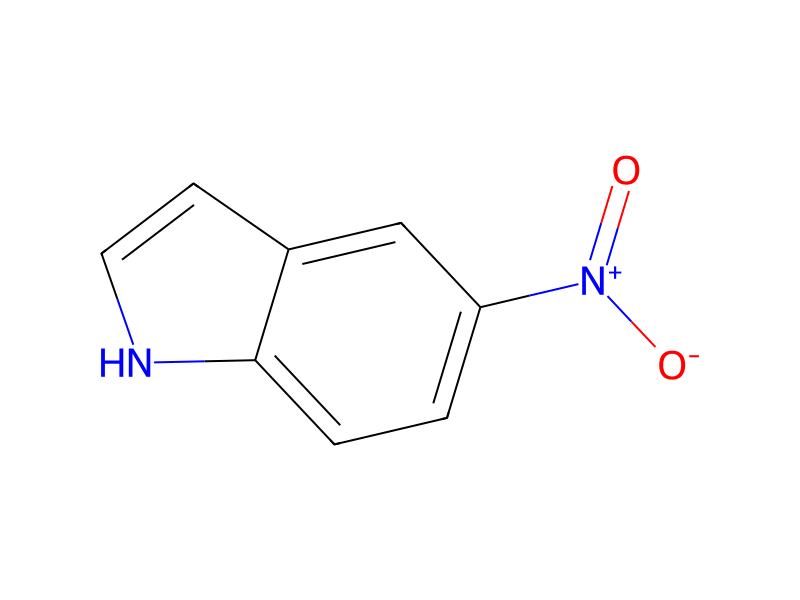
[N+:1]([C:4]1[CH:5]=[C:6]2[C:10](=[CH:11][CH:12]=1)[NH:9][CH:8]=[CH:7]2)([O-:3])=[O:2].[OH-].[Na+].CC1C=C[C:19]([CH3:22])=CC=1.C([O-])([O-])=O.[K+].[K+]>O>[CH2:8]([N:9]([CH2:19][CH3:22])[CH2:10][CH2:6][N:9]1[C:10]2[C:6](=[CH:5][C:4]([N+:1]([O-:3])=[O:2])=[CH:12][CH:11]=2)[CH:7]=[CH:8]1)[CH3:7]Participants
6
Reactant 4



Product 1

Reagents, catalysts & solvents 1

Conditions
- Temperature
- 100 °C
Procedure
A slurry of 5-nitroindole (2.0 g, 12.3 mmol) and NaOH pellets (0.49 g, 1 eq) in H2O (2.0 mL) was stirred at RT. After 10 min, p-xylene (15.0 mL, 1.4 M), K2CO3 (2.55 g, 1.5 equ) and N-diethylaminoethyl chloride hydrochloride (2.12 g, 12.3 mmol, 1 eq) was added, and the reaction mixture was heated to 100° C. After 4 h the reaction mixture was cooled to ambient temperature and concentrated under reduced pressure. The crude residue was dissolved in p-xylene and washed with 1N NaOH (2×) and H2O (1×). The organic layer was dried over MgSO4, filtered, and evaporated under reduced pressure to afford the nitro compound (1.79 g, 56%). TLC (5% MeOH/EtOAc), Rf=0.25; LC MS m/z 262.2 (MH+).
Workup
- temperatureAfter 4 h the reaction mixture was cooled to ambient temperature
- concentrationconcentrated under reduced pressure
- dissolutionThe crude residue was dissolved in p-xylene
- washwashed with 1N NaOH (2×) and H2O (1×)
- dry with materialThe organic layer was dried over MgSO4
- filtrationfiltered
- customevaporated under reduced pressure
Sources & evidence
- ORD record
- ord-ef3f62c823b644c480faf06d2ddc0306
- Source dataset
- uspto-grants-2011_12
- Patent number
- US08076488B2
Reaction notes
Loading…