Triphenylphosphonium bromide → Triphenylphosphine
Reaction equation

Br.[C:2]1([P:8]([C:15]2[CH:20]=[CH:19][CH:18]=[CH:17][CH:16]=2)[C:9]2[CH:14]=[CH:13][CH:12]=[CH:11][CH:10]=2)[CH:7]=[CH:6][CH:5]=[CH:4][CH:3]=1>CO>[C:15]1([P:8]([C:2]2[CH:3]=[CH:4][CH:5]=[CH:6][CH:7]=2)[C:9]2[CH:14]=[CH:13][CH:12]=[CH:11][CH:10]=2)[CH:16]=[CH:17][CH:18]=[CH:19][CH:20]=1Participants
Reactant 1
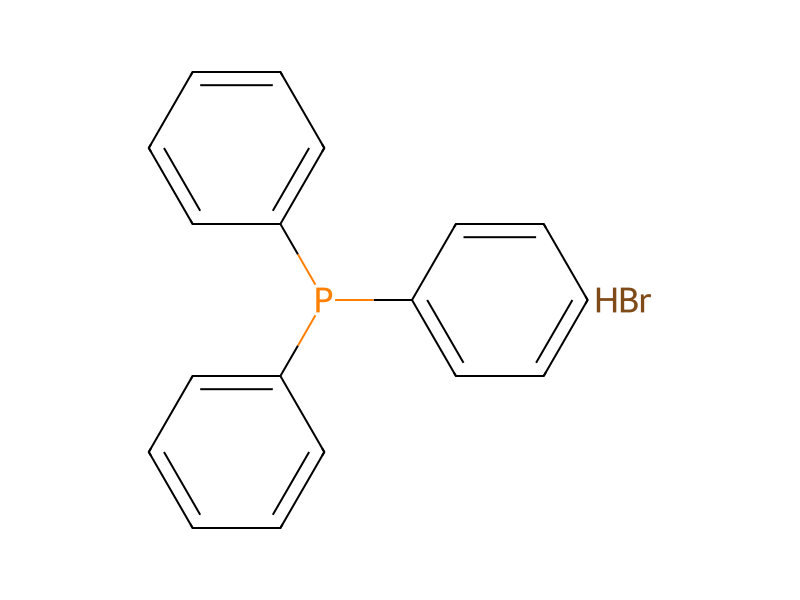
Product 1

Reagents, catalysts & solvents 1

Procedure
To a stirred solution of triphenylphosphine hydrobromide (22.0 g, 64.0 mmol) in MeOH (80 mL) was added a solution of alcohol 2 (8.72 g, 64.0 mmol) in MeOH (70 mL) and the reaction mixture was stirred at room temperature for 48 h. The reaction solution was concentrated under reduced pressure and the residue was triturated with a mixture of acetone (20 mL) and diethyl ether (50 mL). The precipitate was collected by vacuum filtration, washed with diethyl ether (30 mL) and hexanes (30 mL), and concentrated under reduced pressure to provide triphenylphosphine salt 3 as a white solid. Yield (23.0 g, 78%): mp 240-246° C. 1H NMR (300 MHz, DMSO-d6) δ 7.51-7.95 (m, 15H), 7.15 (dt, J=7.7, 2.6 Hz, 1H), 6.96 (d, J=7.7 Hz, 2H), 4.94 (d, J=14.6 Hz, 2H), 1.76 (s, 6H); ESI MS m/z 381 [M−Br]+; HPLC (Method 1) 97.0% (AUC), tR=13.78 min.
Workup
- concentrationThe reaction solution was concentrated under reduced pressure
- customthe residue was triturated with a mixture of acetone (20 mL) and diethyl ether (50 mL)
- filtrationThe precipitate was collected by vacuum filtration
- washwashed with diethyl ether (30 mL) and hexanes (30 mL)
- concentrationconcentrated under reduced pressure
Sources & evidence
- ORD record
- ord-4f98423507f44e42bc7b5265fc5d6d6e
- Source dataset
- uspto-grants-2011_12
- Patent number
- US08076516B2
Reaction notes
Loading…