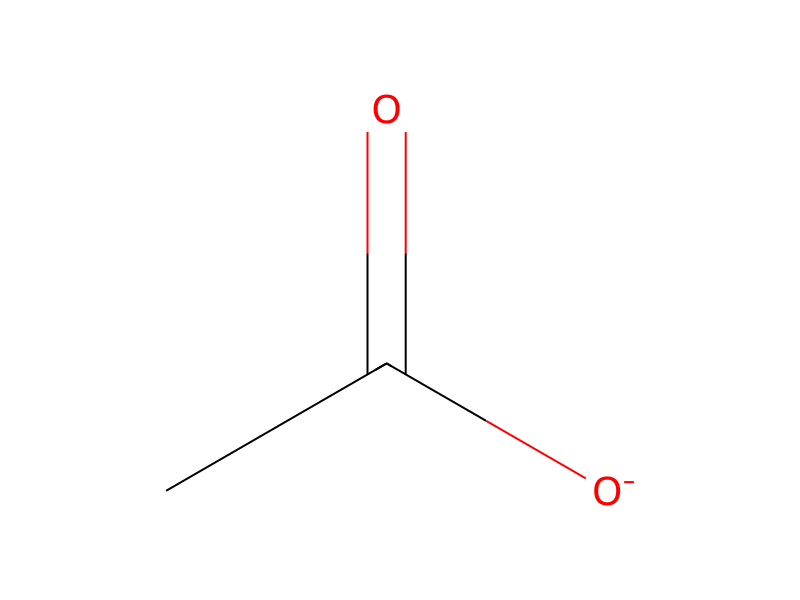
Oxygen → Acetate
Reaction equation

O=O.O=C[C@@H]([C@H]([C@@H]([C@@H](CO)O)O)O)O.[CH2:15]1[C@@H:20]([OH:21])[C@@H:19]([OH:22])[C@H:18]([OH:23])[CH2:17][C@@:16]1([C:25]([OH:27])=[O:26])[OH:24].C1[C@:34](O)([C:35]([OH:37])=[O:36])CC(=O)[C@@H](O)[C@@H]1O>>[CH2:15]1[C@@H:20]([OH:21])[C@@H:19]([OH:22])[C@H:18]([OH:23])[CH2:17][C@@:16]1([C:25]([OH:27])=[O:26])[OH:24].[C:35]([O-:37])(=[O:36])[CH3:34]Participants




Procedure
QP1.1/pKD12.112 was cultured for 60 h under fed-batch fermentor conditions at 37° C., pH 7.0, dissolved oxygen at 10% of saturation and an initial glucose concentration of 23 g/L. Extracellular accumulation of quinic acid began in early to mid log phase of microbial growth as represented by the open boxes in FIG. 2. The dry cell weight is represented by the solid line and closed circles. 3-Dehydroquinate was efficiently converted to quinic acid as there was never a build-up of the intermediate (solid bars in FIG. 2). After 60 hours of cultivation with Kc=0.1, E. coli QP1.1/pKD12.112 synthesized 60 g/L of quinic acid in 23% yield along with only 2.6 g of 3-dehydroquinate. Quinic acid was isolated from the fermentation broth by ion-exchange chromatography on AG1-x8 (acetate form) and Dowex 50 (H+ form) columns. Purified quinic acid was obtained by further recrystallization.
Workup
- customclosed circles
- waitAfter 60 hours of cultivation with Kc=0.1, E
Sources & evidence
- ORD record
- ord-c0ed24d9bb214b79afc34de9b2c740f5
- Source dataset
- uspto-grants-2011_12
- Patent number
- US08080397B2
Reaction notes
Loading…