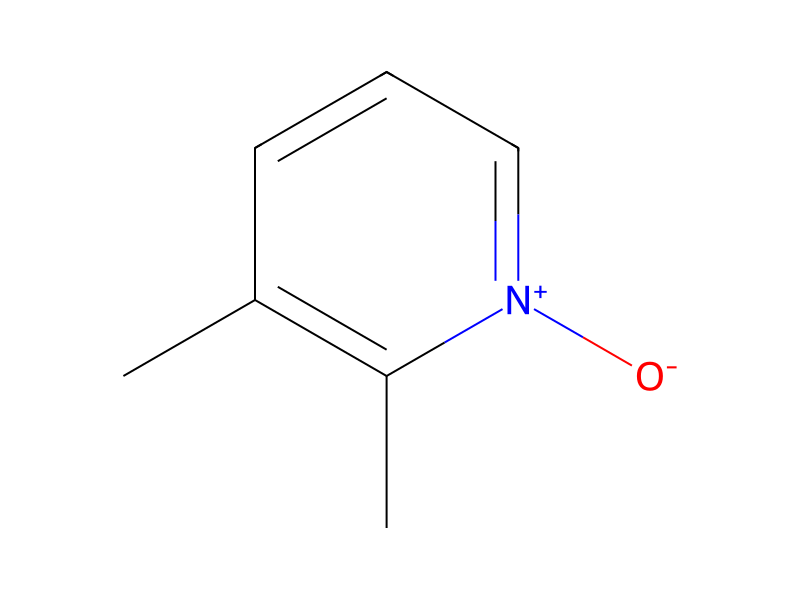
2,3-Lutidine → Pyridine, 2,3-dimethyl-, 1-oxide
Reaction equation

[N:1]1[CH:6]=[CH:5][CH:4]=[C:3]([CH3:7])[C:2]=1[CH3:8].ClC1C=CC=C(C(OO)=[O:17])C=1>C(Cl)(Cl)Cl>[N+:1]1([O-:17])[CH:6]=[CH:5][CH:4]=[C:3]([CH3:7])[C:2]=1[CH3:8]Participants
4
Reactant 2


Product 1
Reagents, catalysts & solvents 1

Conditions
- Temperature
- 0 °C
Procedure
To a stirred solution of 2,3-lutidine (5.00 g, 46.7 mmol) in chloroform (100 mL) at 0° C. was added m-chloroperbenzoic acid (12.0 g of a 77% max reagent) portionwise over 5 min. The reaction mixture was stirred for an additional 30 min at 0° C. and then allowed to warm to room temperature. After 16 h, the reaction mixture was concentrated to dryness, water (20 mL) was added and the pH of the mixture was adjusted to 8 (saturated NaHCO3). The mixture was concentrated and the residue was extracted with dichloromethane/methanol (4:1). The extracts were concentrated to a white solid. Subsequent column purification (SiO2; dichloromethane/methanol, 9:1) gave 2,3-lutidine-N-oxide as a white solid (4.80 g, 83%).
Workup
- temperatureto warm to room temperature
- waitAfter 16 h
- concentrationthe reaction mixture was concentrated to dryness, water (20 mL)
- additionwas added
- concentrationThe mixture was concentrated
- extractionthe residue was extracted with dichloromethane/methanol (4:1)
- concentrationThe extracts were concentrated to a white solid
- customSubsequent column purification (SiO2; dichloromethane/methanol, 9:1)
Sources & evidence
- ORD record
- ord-fc8938b57b934513855dceb6225589a0
- Source dataset
- uspto-grants-2011_12
- Patent number
- US08084459B2
Reaction notes
Loading…