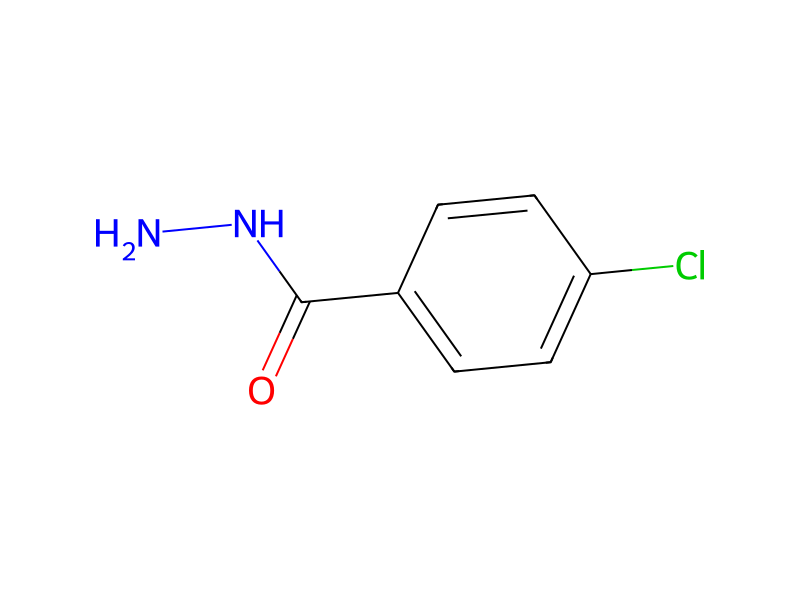
4-Chlorobenzohydrazide → 2-(4-chlorobenzoyl)-N-methylhydrazinecarboxamide
Reaction equation

[CH3:1][NH:2][C:3](=O)[O:4]C1C=CC([N+]([O-])=O)=CC=1.C(N(CC)C(C)C)(C)C.[Cl:24][C:25]1[CH:34]=[CH:33][C:28]([C:29]([NH:31][NH2:32])=[O:30])=[CH:27][CH:26]=1>ClCCl>[Cl:24][C:25]1[CH:34]=[CH:33][C:28]([C:29]([NH:31][NH:32][C:3]([NH:2][CH3:1])=[O:4])=[O:30])=[CH:27][CH:26]=1Participants
5




Procedure
575 mg (2.93 mmol) of 4-nitrophenyl methylcarbamate and 417 mg (3.22 mmol) of N,N-diisopropylethylamine are successively added to 500 mg (2.93 mmol) of 4-chlorobenzoic acid hydrazide in 15 ml dichloromethane and the mixture stirred overnight at room temperature. It is concentrated, the residue is purified by preparative HPLC [Method 9] and 410 mg (61% of theory) of the target compound are thus obtained.
Workup
- concentrationIt is concentrated
- customthe residue is purified by preparative HPLC [Method 9] and 410 mg (61% of theory) of the target compound
- customare thus obtained
Sources & evidence
- ORD record
- ord-06d0fcd864f944228a002254fc4aa65d
- Source dataset
- uspto-grants-2011_12
- Patent number
- US08084481B2
Reaction notes
Loading…