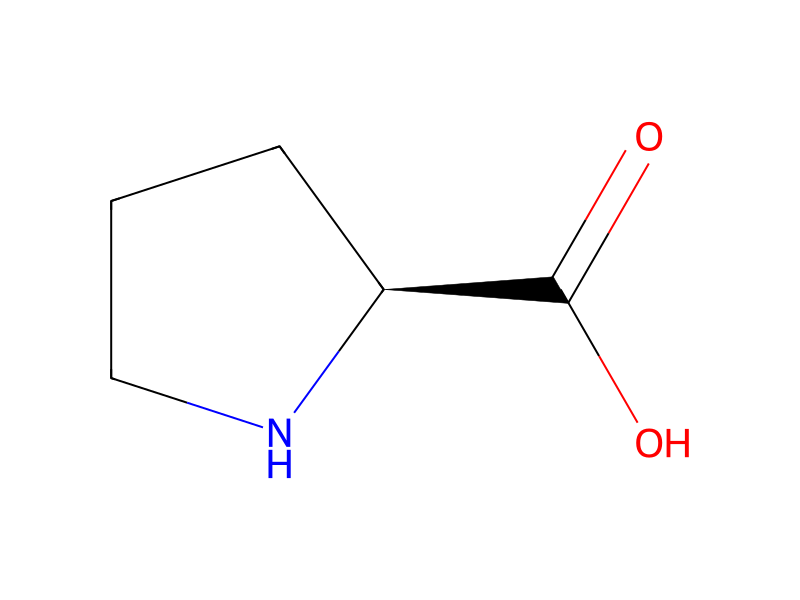
L-Proline → (S)-6-chloro-1,2,3,11a-tetrahydro-5H-pyrrolo[2,1-c][1,4]benzodiazepine-5,11(10H)-dione
Reaction equation

[Cl:1][C:2]1[CH:3]=[CH:4][CH:5]=[C:6]2[NH:12][C:11](=[O:13])[O:10][C:8](=O)[C:7]=12.[NH:14]1[CH2:21][CH2:20][CH2:19][C@H:15]1C(O)=O>CS(C)=O.CN(C)C=O>[Cl:1][C:2]1[C:7]2[C:8](=[O:10])[N:14]3[CH2:21][CH2:20][CH2:19][C@H:15]3[C:11](=[O:13])[NH:12][C:6]=2[CH:5]=[CH:4][CH:3]=1Participants




Procedure
10 g (50.6 mmol) of 6-chloroisatoic acid anhydride are stirred at 110° C. for 2 hours with 5.82 g (50.6 mmol) of L-proline in 80 ml of dimethyl sulphoxide. The solution is evaporated and the residue is crystallised from ethyl acetate. There is obtained (S)-6-chloro-1,2,3,11a-tetrahydro-5H-pyrrolo[2,1-c][1,4]benzodiazepine-5,11(10H)-dione of melting point 264°-266° C. (b) A solution of 4.0 g (16 mmol) of (S)-6-chloro-1,2,3,11a-tetrahydro-5H-pyrrolo[2,1-c][1,4]benzodiazepine-5,11(10)-dione in 30 ml of dimethylformamide is treated under an argon atmosphere with 0.57 g (16 mmol) of sodium hydride (60 percent oil dispersion) and stirred at room temperature for 1 hour. 3.02 g (17.5 mmol) of diethylchlorophosphate are added dropwise to the thus-obtained suspension at -20° C. and the mixture is stirred at this temperature for 10 minutes.
Workup
- customThe solution is evaporated
- customthe residue is crystallised from ethyl acetate
Sources & evidence
- ORD record
- ord-022dd5f6c8b44cc98582095025e38804
- Source dataset
- uspto-grants-1982_08
- Patent number
- US04346030
Reaction notes
Loading…