4-Methylbenzaldehyde → 1-(4-Methylphenyl)-7-chloro-1-hepten-3-one
Reaction equation

[Cl-:1].[O:2]1[CH2:7][CH2:6][CH2:5][CH2:4][C:3]1=[CH:8][P+](C1C=CC=CC=1)(C1C=CC=CC=1)C1C=CC=CC=1.[CH3:28][C:29]1[CH:36]=[CH:35][C:32]([CH:33]=O)=[CH:31][CH:30]=1>C1(C)C(C)=CC=CC=1>[CH3:28][C:29]1[CH:36]=[CH:35][C:32]([CH:33]=[CH:8][C:3](=[O:2])[CH2:4][CH2:5][CH2:6][CH2:7][Cl:1])=[CH:31][CH:30]=1Participants
Reactant 2
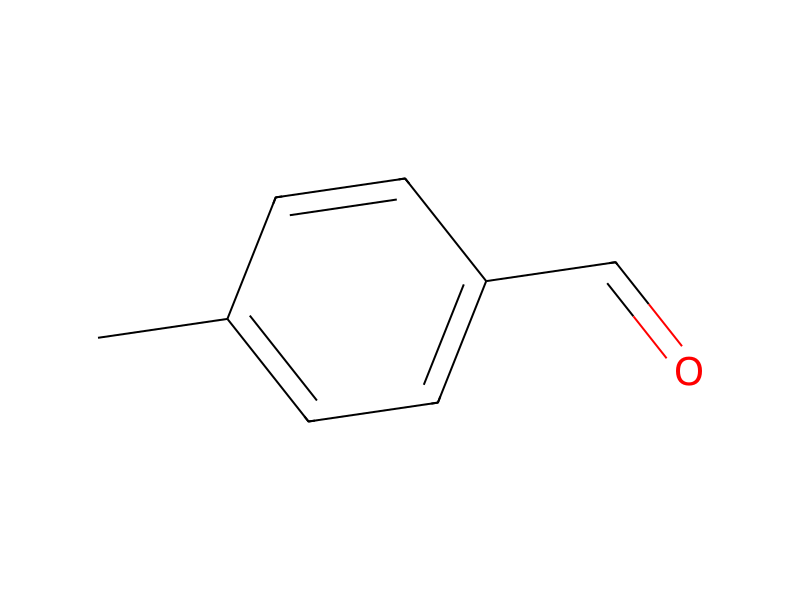

Product 1

Reagents, catalysts & solvents 1

Procedure
2 parts of [(tetrahydro-2H-pyran-2-ylidene)methyl] triphenylphosphonium chloride and 0.82 part of 4-methylbenzaldehyde were combined in 45 parts of xylene. This suspension was maintained under a nitrogen atmosphere and was refluxed for 4.5 hours to produce a clear solution. After the solution was cooled to room temperature, the xylene was removed at a temperature of about 40° C., under reduced pressure to yield a product mixture. This mixture was separated chromatographically on a silica column using as an elution solvent increasing concentrations of ethyl acetate in toluene, to yield 1-(4-methylphenyl)-7-chloro-1-hepten-3-one in the fraction containing 1.5 percent by volume of ethyl acetate in toluene which, after recrystallization from cyclohexane, melted at about 79°-82° C.
Workup
- temperatureThis suspension was maintained under a nitrogen atmosphere
- temperaturewas refluxed for 4.5 hours
- customto produce a clear solution
- customthe xylene was removed at a temperature of about 40° C., under reduced pressure
- customto yield a product mixture
- customThis mixture was separated chromatographically on a silica column
- temperatureincreasing concentrations of ethyl acetate in toluene
Sources & evidence
- ORD record
- ord-2f9b8dfaf3e9489a8398eb93d704bf98
- Source dataset
- uspto-grants-1982_08
- Patent number
- US04347192
Reaction notes
Loading…