Hydrochloric Acid → 3-fluoro-N-isopropyl-4-(piperazin-1-yl)benzamide hydrochloride
Reaction equation
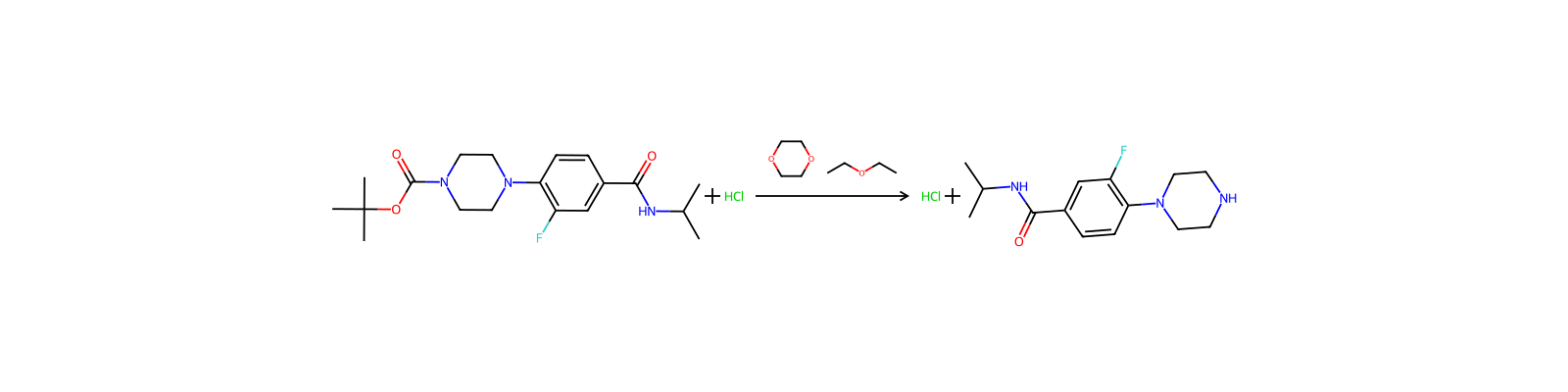
[F:1][C:2]1[CH:7]=[C:6]([C:8](=[O:13])[NH:9][CH:10]([CH3:12])[CH3:11])[CH:5]=[CH:4][C:3]=1[N:14]1[CH2:19][CH2:18][N:17](C(OC(C)(C)C)=O)[CH2:16][CH2:15]1.[ClH:27]>O1CCOCC1.C(OCC)C>[ClH:27].[F:1][C:2]1[CH:7]=[C:6]([CH:5]=[CH:4][C:3]=1[N:14]1[CH2:15][CH2:16][NH:17][CH2:18][CH2:19]1)[C:8]([NH:9][CH:10]([CH3:12])[CH3:11])=[O:13]Participants
5
Reactant 2


Product 1

Reagents, catalysts & solvents 2


Procedure
Tert-butyl 4-(2-fluoro-4-(isopropylcarbamoyl)phenyl)piperazine-1-carboxylate (1.10 g, 3.01 mmol) was diluted with 4.0M HCl in dioxane (3 mL) and stirred for 30 min. The thick white precipitate that formed was diluted with ethyl ether (10 mL) and stirred until a fine suspension resulted. The precipitate was filtered under nitrogen and dried in vacuum to afford 3-fluoro-N-isopropyl-4-(piperazin-1-yl)benzamide hydrochloride as a white solid. ESI-MS: m/z 302 (M+H)+.
Workup
- customThe thick white precipitate that formed
- stirringstirred until a fine suspension
- customresulted
- filtrationThe precipitate was filtered under nitrogen
- customdried in vacuum
Sources & evidence
- ORD record
- ord-79a494c273d84bdb840728cec798208e
- Source dataset
- uspto-grants-2014_09
- Patent number
- US08822470B2
Reaction notes
Loading…