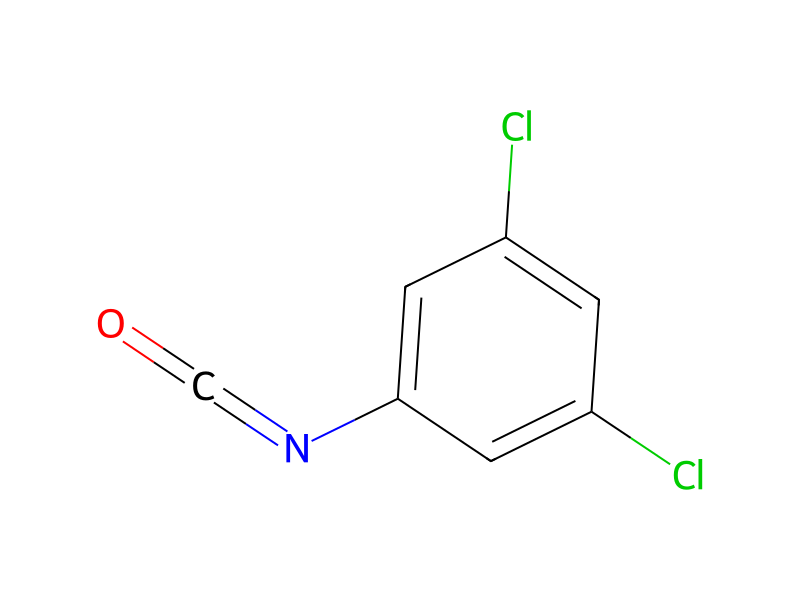
3,5-Dichlorophenyl isocyanate → HCID 9861625, compound
Reaction equation

[Cl:1][C:2]1[CH:3]=[C:4]([N:9]=[C:10]=[O:11])[CH:5]=[C:6]([Cl:8])[CH:7]=1.[N:12]12[CH2:19][CH2:18][CH:15]([CH2:16][CH2:17]1)[CH:14]([NH2:20])[CH2:13]2>C1(C)C=CC=CC=1.C1COCC1>[N:12]12[CH2:19][CH2:18][CH:15]([CH2:16][CH2:17]1)[CH:14]([NH:20][C:10]([NH:9][C:4]1[CH:3]=[C:2]([Cl:1])[CH:7]=[C:6]([Cl:8])[CH:5]=1)=[O:11])[CH2:13]2Participants
5
Reactant 2

Product 1

Reagents, catalysts & solvents 2


Procedure
A solution of 3,5-dichlorophenyl isocyanate (1.88 g, 10 mmol) in toluene (20 ml) was added at 0° to 1-azabicyclo[2.2.2]octan-3-amine (3-aminoquinuclidine) (1.26 g, 10 mmol) in THF (40 ml). The mixture was stirred at room temperature overnight and evaporated to dryness. The residue was partitioned between ether and dilute hydrochloric acid. The aqueous phase was basified with potassium carbonate and extracted with ethyl acetate. The dried (Na2SO4)ethyl acetate phase was evaporated and the residue (1.64 g) converted to the 1:1 oxalate, quarter hydrate, mp 208°-209° C. (dec).
Workup
- customevaporated to dryness
- customThe residue was partitioned between ether and dilute hydrochloric acid
- extractionextracted with ethyl acetate
- customThe dried (Na2SO4)ethyl acetate phase was evaporated
Sources & evidence
- ORD record
- ord-fc657b0a0263441d8cd83e21f2cbe1bd
- Source dataset
- uspto-grants-1991_01
- Patent number
- US04983600
Reaction notes
Loading…