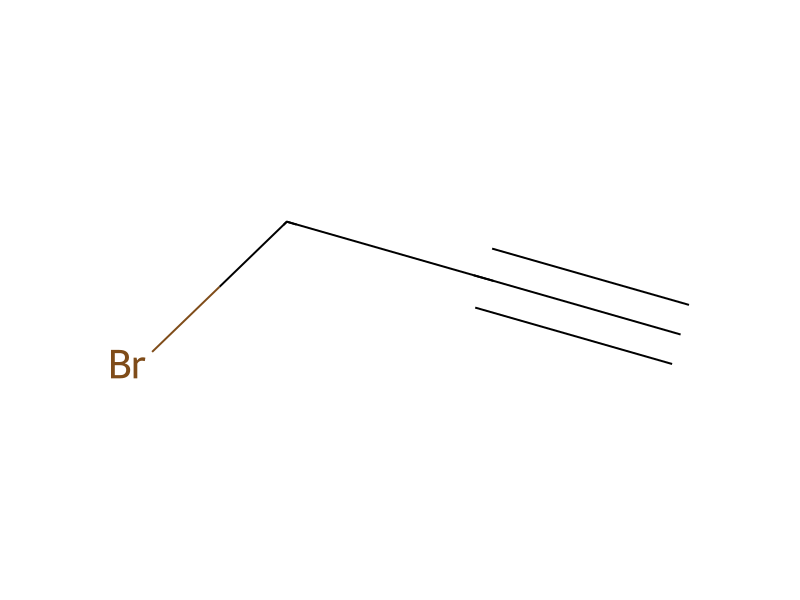
Propargyl bromide → HCID 57130733, compound
Reaction equation

[F:1][C:2]1[CH:7]=[C:6]([Br:8])[C:5]([OH:9])=[CH:4][C:3]=1[N:10]1[C:14](=[O:15])[C:13](=[C:16]([CH2:18][CH3:19])[CH3:17])[O:12][C:11]1=[O:20].C(=O)([O-])[O-].[K+].[K+].[CH2:27](Br)[C:28]#[CH:29]>C(#N)C>[F:1][C:2]1[CH:7]=[C:6]([Br:8])[C:5]([O:9][CH2:29][C:28]#[CH:27])=[CH:4][C:3]=1[N:10]1[C:14](=[O:15])[C:13](=[C:16]([CH2:18][CH3:19])[CH3:17])[O:12][C:11]1=[O:20]Participants
5
Reactant 3


Product 1

Reagents, catalysts & solvents 1

Procedure
To an acetonitrile solution (25 ml) of 3-(2'-fluoro-4'-bromo-5'-hydroxyphenyl)-5-(sec-butylidene)-1,3-oxazolidine-2,4-dione (0.26 g, 0.82 mmol) was added potassium carbonate (0.11 g) and the mixture was heated at reflux for 1 hour. After the addition of propargyl bromide (0.1 g, 0.83 mmol), the reaction mixture was further refluxed for 1 hour. 3-(2'-fluoro-4'-bromo-5'-propargyloxyphenyl)-5-(sec-butylidene)-1,3-oxazolidine-2,4-dione (0.24 g, 77% yield) was obtained by an operation similar to that of Example 1.
Workup
- temperaturethe mixture was heated
- temperatureat reflux for 1 hour
- temperaturethe reaction mixture was further refluxed for 1 hour
Sources & evidence
- ORD record
- ord-8c796698276a4b0d8bd145a1ef24e808
- Source dataset
- uspto-grants-1991_01
- Patent number
- US04983751
Reaction notes
Loading…