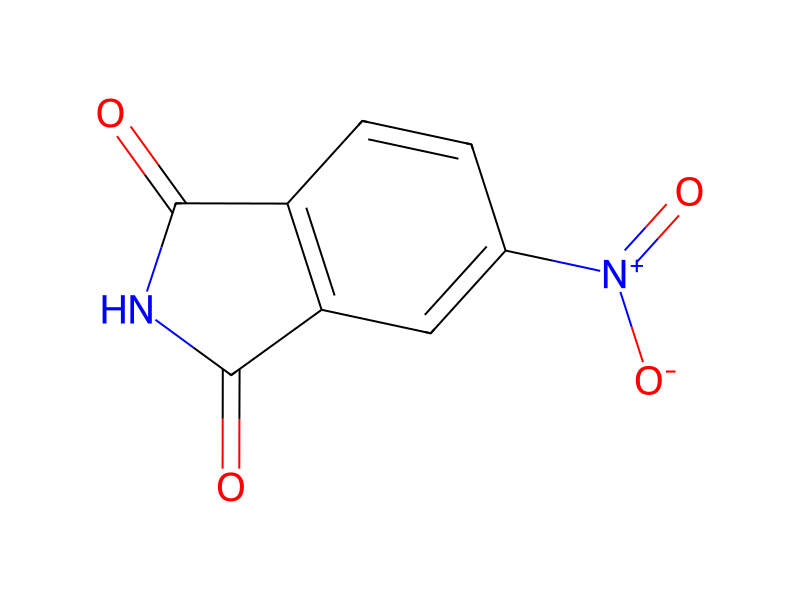
4-Nitrophthalimide → (5-Nitro-1,3-dioxo-1,3-dihydro-isoindol-2-yl)-acetic acid ethyl ester
Reaction equation

[N+:1]([C:4]1[CH:5]=[C:6]2[C:11](=[O:12])[NH:10][C:8](=[O:9])[C:7]2=[CH:13][CH:14]=1)([O-:3])=[O:2].Br[CH2:16][C:17]([O:19][CH2:20][CH3:21])=[O:18].C(=O)([O-])[O-].[K+].[K+]>CC(C)=O>[CH2:20]([O:19][C:17](=[O:18])[CH2:16][N:10]1[C:11](=[O:12])[C:6]2[C:7](=[CH:13][CH:14]=[C:4]([N+:1]([O-:3])=[O:2])[CH:5]=2)[C:8]1=[O:9])[CH3:21]Participants
5
Reactant 3


Product 1

Reagents, catalysts & solvents 1

Procedure
A mixture of 4-nitrophthalimide (82.54 g, 0.43 mol), ethyl bromoacetate (78.92 g, 0.47 mol) and potassium carbonate (130.6 g, 0.94 mol), and acetone (1.5 l) was refluxed for eighteen hours before it was cooled to room temperature, filtered and concentrated in vacuo. The residue was partitioned between dichloromethane and water. The organic layer was dried over anhydrous sodium sulfate and concentrated in vacuo to give the title compound as a yellow solid (107.39 g): MS: (+) m/z 279.25 (M+1).
Workup
- temperaturewas refluxed for eighteen hours before it
- filtrationfiltered
- concentrationconcentrated in vacuo
- customThe residue was partitioned between dichloromethane and water
- dry with materialThe organic layer was dried over anhydrous sodium sulfate
- concentrationconcentrated in vacuo
Sources & evidence
- ORD record
- ord-52c7b5dc218d4b30ae3e397850f5ceaf
- Source dataset
- uspto-grants-2015_11
- Patent number
- US09174976B2
Reaction notes
Loading…