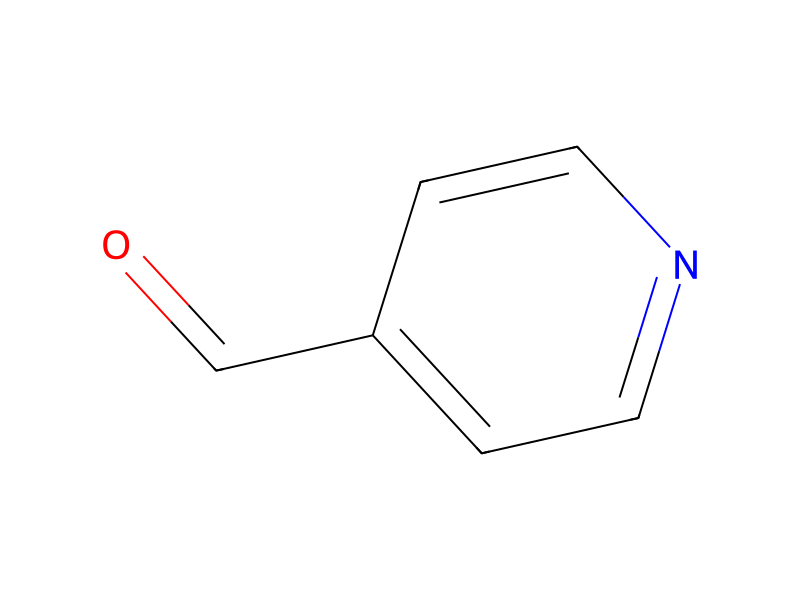
4-Pyridinecarboxaldehyde → Gapicomine
Reaction equation

[N:1]1[CH:6]=[CH:5][C:4]([CH:7]=O)=[CH:3][CH:2]=1.[NH2:9][CH2:10][C:11]1[CH:16]=[CH:15][N:14]=[CH:13][CH:12]=1>>[N:1]1[CH:6]=[CH:5][C:4]([CH2:7][NH:9][CH2:10][C:11]2[CH:16]=[CH:15][N:14]=[CH:13][CH:12]=2)=[CH:3][CH:2]=1Participants


Procedure
In this Example, reductive amination of 4-pyridine-carboxaldehyde (2) with 4-(aminomethyl)pyridine (1) was carried out using a one-pot two-step protocol to produce bis((pyridin-4-yl)methyl)amine (4). Time-resolved mass spectra of the aldehyde-amine condensation step and the imine reduction step are shown in FIG. 16. Ions were identified according to their m/z values and confirmed by tandem mass experiment. Reactant 1 was first injected into the methanol reaction solvent. Ions of protonated 1 at m/z 109 were detected at 0.4 min later, on the heels of which the protonated dimer at m/z 217 appeared and reached its steady state within 4.8 s. (FIG. 16 panels A-B) After reactant 2 was injected into the reaction solution and the protonated methanol adduct ions of the monomer and dimer of 2 at m/z 140 and 279 showed up. The ions of the intermediate (pyridin-4-yl)-N-((pyridin-4-yl)methylene)methanamine (3) at m/z 198 and 230 formed quickly and the intensity increased sharply (FIG. 16 panel C). The intensity of ions of 1 decreased but the ions did not disappear, which corresponded to the fact that this is an equilibrium reaction (FIG. 16 panel D). About 50 min later, sodium borohydride solution was injected into the system. The sodiated adduct ions of product 4 at m/z 222 started to appear, while the intermediate ions of 3 decreased a lot (FIG. 16 panel E). Ten minutes later, the peak of the product 4 was reaching its highest intensity (FIG. 16 panel F). The selected ion chronogram shows dynamic changing of ions corresponding to the precursor 1, intermediate 3 and product 4 (FIG. 17). The kinetic process of reductive amination can be clearly seen. The first condensation step of this reaction happened very fast; once 2 was added to the solution of 1, it took less than 1 min for the reaction to reach equilibrium. The intermediate 3 was generated simultaneously with the decrease of 1. The second reduction step was not as fast as the first step. With the reduction of intermediate 3, the first step was driven to the right. Thus ions of 1 were depleted. Altogether, it took around 10 min for the product 4 to reach its highest intensity. The total monitoring time was 90 min without any clogging in the fused-silica capillary using high concentrations of reaction solution that are representative of those of industrial interest.
Sources & evidence
- ORD record
- ord-edcdce1302e04544970926d5b33f706e
- Source dataset
- uspto-grants-2015_11
- Patent number
- US09184036B2
Reaction notes
Loading…