Diethyl Malonate → HCID 178518204, compound
Reaction equation

CO/N=C(/C1OCCON=1)\C1C=CC=CC=1[O:11][C:12]1[N:17]=[CH:16][N:15]=[C:14]([O:18]C2C=CC=CC=2Cl)[C:13]=1[F:26].C(OCC)(=O)CC(OCC)=O.S(Cl)(Cl)(=O)=O.ClC(C(OCC)=O)C(OCC)=O.FC(C(OCC)=O)C(OCC)=O>C(N)=O>[F:26][C:13]1[C:14]([OH:18])=[N:15][CH:16]=[N:17][C:12]=1[OH:11]Participants
Reactant 5
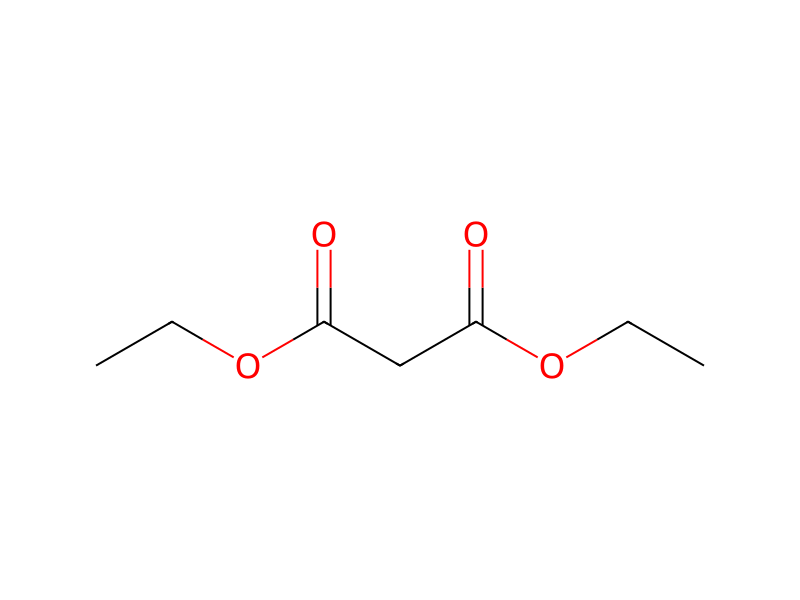

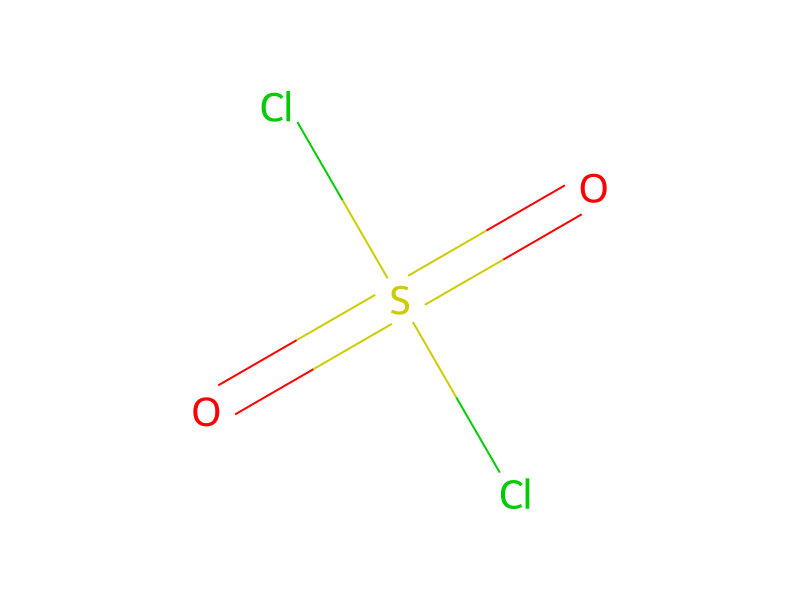


Product 1

Reagents, catalysts & solvents 1
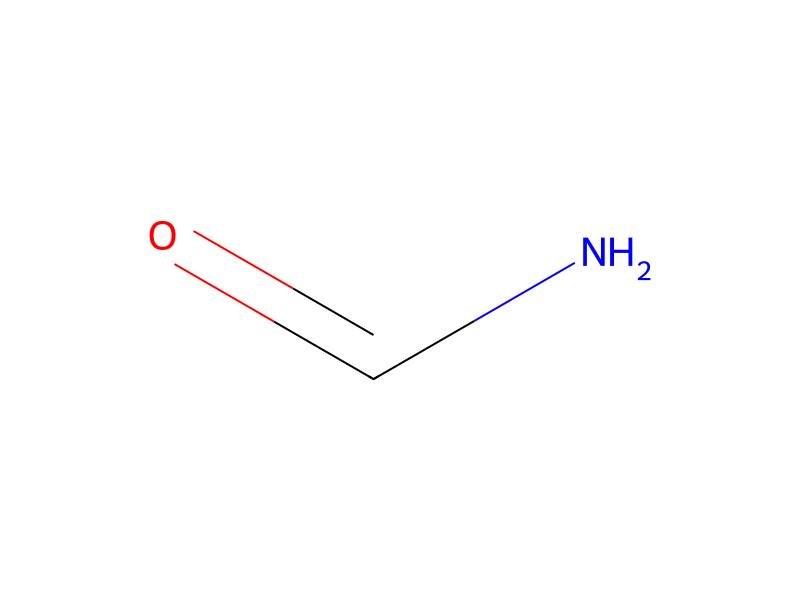
Procedure
An exemplary approach to fluoxastrobin is illustrated in Scheme 1. According to Scheme 1, the synthesis begins with chlorination of diethyl malonate (1) with a suitable chlorinating agent, for example, sulfuryl chloride. The resulting diethyl 2-chloromalonate (2) is converted to diethyl 2-fluoromalonate (3) with a suitable fluorinating reagent, such as a hydrogen fluoride-triethylamine complex. The ensuing cyclization in formamide provides 5-fluoropyrimidine-4,6-diol (4), which is treated with a suitable chlorinating agent, for example phosphorus oxychloride to give 4,6-dichloro-5-fluoropyrimidine (5). As further indicated in Scheme 2, 4,6-dichloro-5-fluoropyrimidine (5) is reacted with (E)-(5,6-dihydro-1,4,2-dioxazin-3-yl)(2-hydroxyphenyl)methanone O-methyl oxime (13) in an appropriate solvent and in the presence of a base to yield (E)-(2-((6-halo-5-fluoropyrimidin-4-yl)oxy)phenyl)(5,6-dihydro-1,4,2-dioxazin-3-yl)methanone O-methyl oxime (14), which is further reacted with 2-chlorophenol to give fluoxastrobin. As described above, the last two steps of the synthesis may be carried out as a one-pot process, i.e. without isolation of the intermediate, (E)-(2-((6-halo-5-fluoropyrimidin-4-yl)oxy)phenyl)(5,6-dihydro-1,4,2-dioxazin-3-yl)methanone O-methyl oxime (14).
Sources & evidence
- ORD record
- ord-07cd9299378244248c7f6daf403de4d1
- Source dataset
- uspto-grants-2015_11
- Patent number
- US09193698B2
Reaction notes
Loading…