Phosphorus oxybromide → Methyl 3-bromo-2-phenylquinoxaline-6-carboxylate
Reaction equation

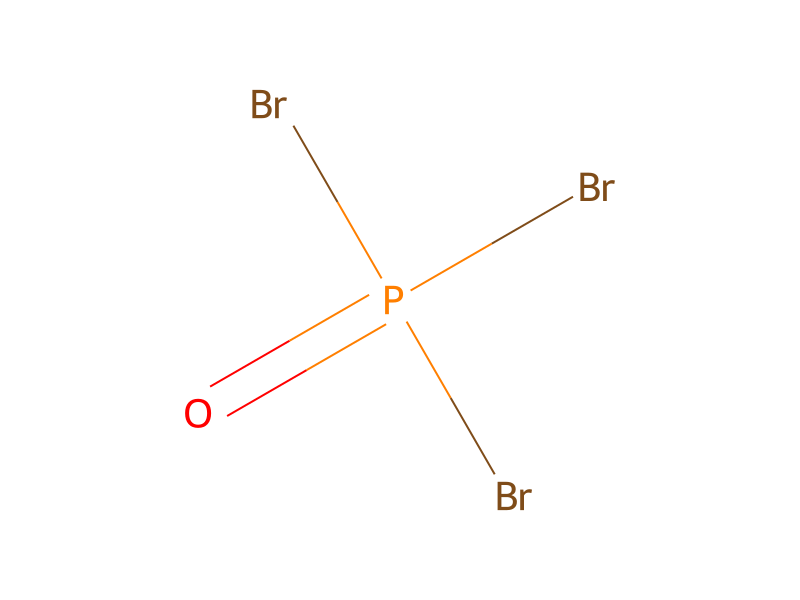
O=[C:2]1[NH:11][C:10]2[C:5](=[CH:6][CH:7]=[C:8]([C:12]([O:14][CH3:15])=[O:13])[CH:9]=2)[N:4]=[C:3]1[C:16]1[CH:21]=[CH:20][CH:19]=[CH:18][CH:17]=1.P(Br)(Br)([Br:24])=O>CC#N>[Br:24][C:2]1[C:3]([C:16]2[CH:21]=[CH:20][CH:19]=[CH:18][CH:17]=2)=[N:4][C:5]2[C:10]([N:11]=1)=[CH:9][C:8]([C:12]([O:14][CH3:15])=[O:13])=[CH:7][CH:6]=2Participants
Reactant 2

Product 1

Reagents, catalysts & solvents 1

Procedure
A solution of methyl 3-oxo-2-phenyl-3,4-dihydroquinoxaline-6-carboxylate (2.1 g, 7.50 mmol, 1.00 equiv) and POBr3 (21.5 g, 74.91 mmol, 10.00 equiv) in CH3CN (120 mL) in a 1000-mL round-bottom flask was heated under reflux overnight in an oil bath. The resulting mixture was concentrated under vacuum; the pH value was adjusted to 7-8 with aqueous sodium bicarbonate (saturated), and the solution extracted with 4×100 mL of dichloromethane. The organic layers were combined, dried over anhydrous sodium sulfate and concentrated under vacuum, giving 2 g (78%) of methyl 3-bromo-2-phenylquinoxaline-6-carboxylate as a white solid. LC-MS (ES, m/z): 343 [M+H]+. 1H-NMR (300 MHz, DMSO-d6) 8.620-8.615 (d, J=1.5 Hz, 1H), 8.38-8.35 (q, J=3.3 Hz, 1H), 8.28-8.25 (d, J=8.7 Hz, 1H), 7.85-7.82 (q, J=6 Hz, 2H), 7.60-7.58 (t, J=2.4 Hz, 3H), 3.99 (s, 3H).
Workup
- temperatureunder reflux overnight in an oil bath
- concentrationThe resulting mixture was concentrated under vacuum
- extractionthe solution extracted with 4×100 mL of dichloromethane
- dry with materialdried over anhydrous sodium sulfate
- concentrationconcentrated under vacuum
Sources & evidence
- ORD record
- ord-b2ace6d85749414e8a2451e0ad656a84
- Source dataset
- uspto-grants-2015_11
- Patent number
- US09193693B2
Reaction notes
Loading…