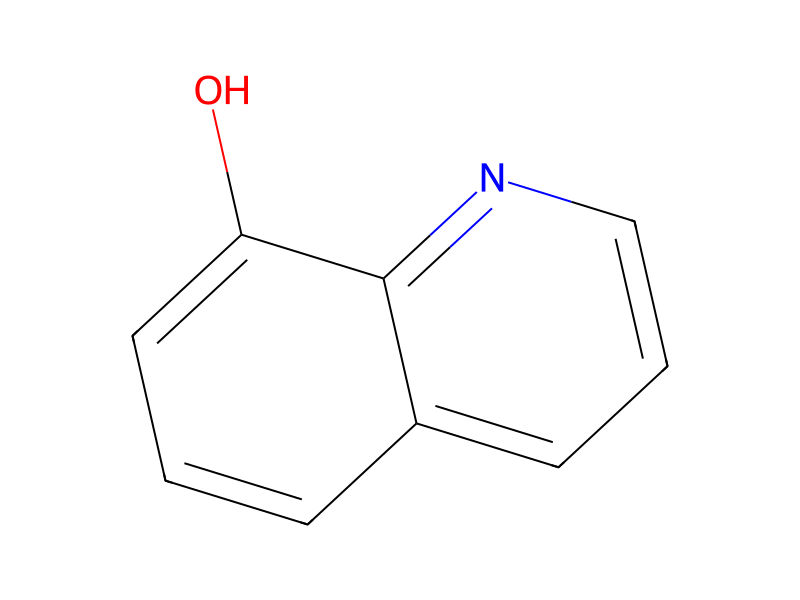
8-Hydroxyquinoline → HCID 135839353, compound
Reaction equation

OC1C=CC=C2[C:11]=1[N:10]=CC=C2.[C-:12]#[N:13].[K+].[Cl:15][C:16]1[C:17](=[O:28])[C:18]2[CH:19]=[CH:20][CH:21]=[N:22][C:23]=2[C:24](=[O:27])[C:25]=1[Cl:26]>O.C1COCC1.CO>[Cl:15][C:16]1[C:17](=[O:28])[C:18]2[CH:19]=[CH:20][CH:21]=[N:22][C:23]=2[C:24](=[O:27])[C:25]=1[Cl:26].[C:12]([C:16]1[C:17]([OH:28])=[C:18]2[C:23](=[C:24]([OH:27])[C:25]=1[C:11]#[N:10])[N:22]=[CH:21][CH:20]=[CH:19]2)#[N:13]Participants




Procedure
6,7-Dichloro-5,8-quinolinedione 2 was prepared in low yield from commercially available 8-hydroxyquinoline 1 by modification of a literature procedure (Shaikh, I. A.; Johnson, F.; Grollman, A. P. J. Med. Chem. 1986, 29, 1329). A solution of potassium cyanide (1.02 g; 16 mmol) in water (3 mL) was added to a boiling solution of the dichloroquinone 2 (794 mg; 3.48 mmol) in THF/methanol (1:1, 40 mL) and heating was continued for a further 2 min. The reaction mixture was concentrated to half-volume and diluted to the original volume with water. Hydrochloric acid (10 M) was added cautiously [Caution: HCN fumes] causing the reaction mixture to change from an olive-green solution to a pale brown suspension. The solid was filtered off, washed with water and air dried overnight thereby affording the dinitrile 3 as a chocolate-brown solid (509 mg, 69%). 1H NMR (CDCl3) δ 7.73 (1H, dd, J=8.6, 4.2 Hz), 8.75 (1H, dd, J=8.6, 1.5 Hz), 9.14 (1H, dd, J=4.2, 1.5 Hz), 13C NMR (d6-DMSO) δ 92.8, 93.1, 115.2, 115.4, 124.4, 125.1, 133.2, 141.1, 152.4, 152.6, 154.4.
Workup
- temperatureheating
- concentrationThe reaction mixture was concentrated to half-volume
- additiondiluted to the original volume with water
- additionHydrochloric acid (10 M) was added cautiously [Caution: HCN fumes]
- filtrationThe solid was filtered off
- washwashed with water and air
- customdried overnight
Sources & evidence
- ORD record
- ord-5b708525255d43069ff952de16a0abe7
- Source dataset
- uspto-grants-2006_11
- Patent number
- US07138391B2
Reaction notes
Loading…