Octane → (R)-(+)-1-Benzyl-3-pyrrolidinol
Reaction equation

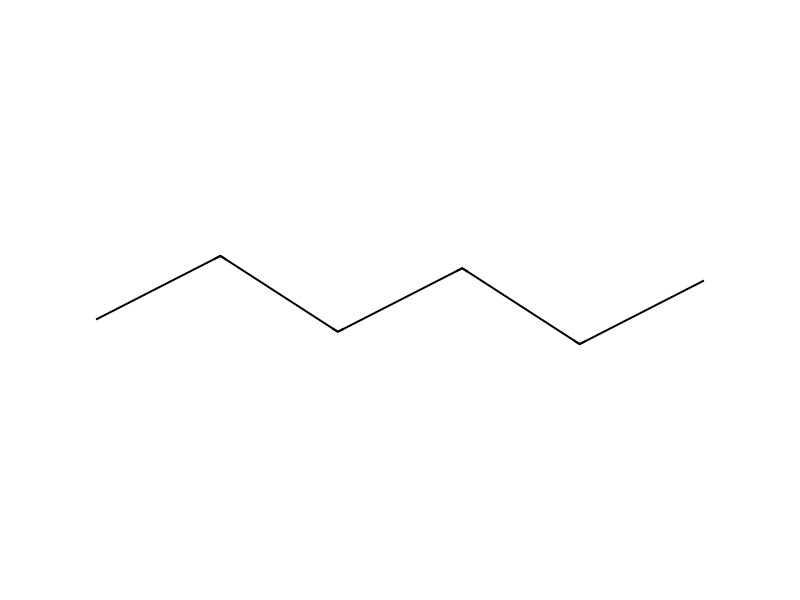
C(N1CCCC1)C1C=CC=CC=1.[CH2:13]([N:20]1[CH2:24][CH2:23][CH:22]([OH:25])[CH2:21]1)[C:14]1[CH:19]=[CH:18][CH:17]=[CH:16][CH:15]=1.CCCCCCCC.CCCCCCCCCC>CCCCCC>[CH2:13]([N:20]1[CH2:24][CH2:23][C@@H:22]([OH:25])[CH2:21]1)[C:14]1[CH:15]=[CH:16][CH:17]=[CH:18][CH:19]=1Participants
Reactant 4


Product 1

Reagents, catalysts & solvents 1
Procedure
It has been found that alkane-degrading microorganisms are excellent biocatalysts for the hydroxylation of N-benzylpyrrolidine to optically active N-benzyl-3-hydroxy-pyrrolidine. Examples are bacteria degrading n-alkane containing 4 or more C-atoms. By screening with a microtiter plate, 25 of a set of 70 strains degrading n-hexane, n-octane, n-decane, or n-dodedane, were found to be able to catalyse this hydroxylation (example 5). The enantioselectivity and relative activity of 14 selected alkane-degrading strains are shown in table 3 (example 6). Hydroxylation of N-benzylpyrrolidine with Pseudomonas putida P1 gave (R)-N-benzyl-3-hydroxypyrrolidine in 62% e.e.; hydroxylation of N-benzylpyrrolidine with the isolate HXN-1100 gave (R)-N-benzyl-3-hydroxypyrrolidine in 70% e.e.; surprisingly, hydroxylation of N-benzylpyrrolidine with the isolate HXN-200 gave (S)-N-benzyl-3-hydroxypyrrolidine in 53% e.e. (Pseudomonas putida P1 was isolated with n-octane as carbon source by van Beilen, J., ETH Zurich; the isolates HXN-1100 and HXN-200 were isolated with n-hexane as carbon source by Engesser, K.-H. and Plaggemeier, Th., University of Stuttgart; all these strains are in the strain collection of institute of Biotechnology, ETH Zurich).
Sources & evidence
- ORD record
- ord-3e391f8587f04aff8b663f6c6a4448ce
- Source dataset
- uspto-grants-2006_11
- Patent number
- US07141412B2
Reaction notes
Loading…