Methyl chloroformate → HCID 21880821, compound
Reaction equation

[CH2:1]([C:4]1[CH:9]=[CH:8][CH:7]=[C:6]([CH2:10][CH:11]=[CH2:12])[C:5]=1[OH:13])[CH:2]=[CH2:3].Cl[C:15]([O:17][CH3:18])=[O:16]>C(N(CC)CC)C>[C:15](=[O:16])([O:17][CH3:18])[O:13][C:5]1[C:4]([CH2:1][CH:2]=[CH2:3])=[CH:9][CH:8]=[CH:7][C:6]=1[CH2:10][CH:11]=[CH2:12]Participants
Reactant 2
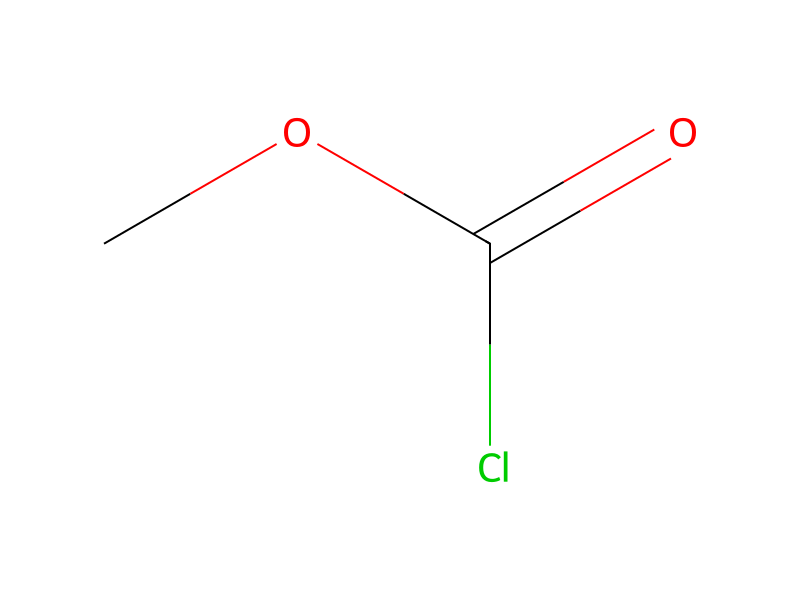

Product 1

Reagents, catalysts & solvents 1

Procedure
2,6-Diallylphenol (3.48, 0.02 mol) and triethylamine (4 ml) was diluted with 1,2-dichloromethane (50 ml). Methyl chloroformate (2.00 gm, 0.027 mol) was diluted with 1,2-dichloromethane (10 ml) and added drop wise to the phenol-amine solution. After the addition was complete, the reaction was refluxed for 1 hr, cooled and poured onto water. The organic layer was washed with water (2×) dried over MgSO4 and evaporated to give 2,6-diallylphenyl methyl carbonate. MS m/z 232 (M+ calcd for C15H16O3=232). H NMR (300 MHz, CDCl3) d 3.30–3.40 (d, 4. CH2), 3.90 (s, 3, CH3), 5.05–5.20 (m, 4, CH2 vinyl), 5.85–6.00 (m, 2, CH vinyl), 7.10–7.27 (m, 3, aromatic). Oxidation of the product as described in Example 1 gave 2,6-di(2,3-epoxypropyl)phenyl methyl carbonate as an oil. MS m/z 264 (M+ calcd for C14H16O5=264). H NMR (300 MHz, CDCl3) d 2.60–2.70 (m, 2, CH2 epoxypropyl), 2.40–2.90 (m, 6, CH2 epoxypropyl), 3.25–3.40 (m, 2, CH2 epoxypropyl), 3.85 (s, 3, OCH3), 7.30–7.65 (m, 3, aromatic).
Workup
- additionAfter the addition
- temperaturethe reaction was refluxed for 1 hr
- temperaturecooled
- additionpoured onto water
- washThe organic layer was washed with water (2×)
- dry with materialdried over MgSO4
- customevaporated
Sources & evidence
- ORD record
- ord-6e4bdb8596a546a59e66e30c5b7dec69
- Source dataset
- uspto-grants-2006_11
- Patent number
- US07141684B2
Reaction notes
Loading…