Phosphorus oxychloride → 1-(3,4-Dimethoxy-5-nitrophenyl)-3,4-dihydroisoquinoline
Reaction equation
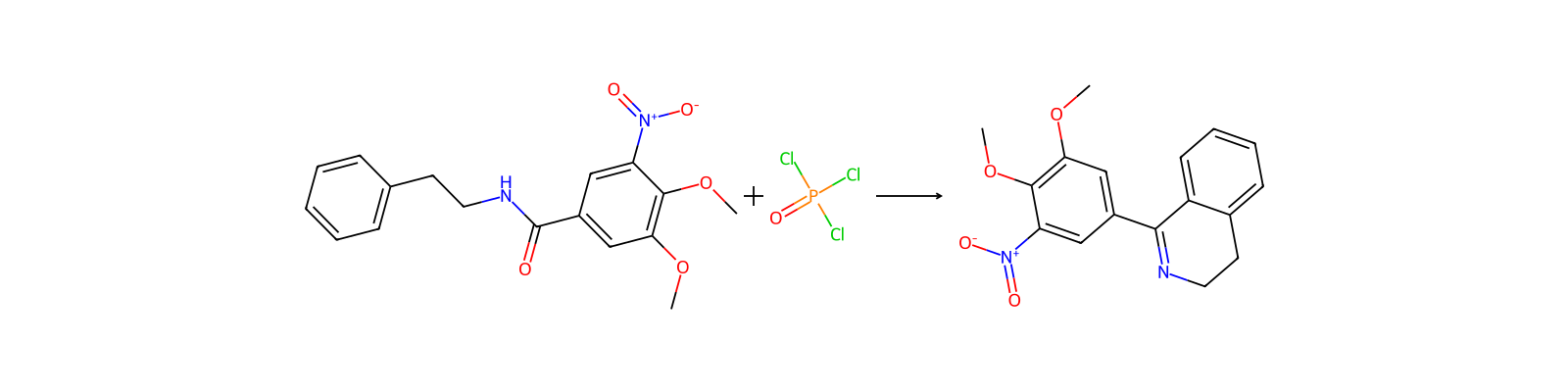
[CH3:1][O:2][C:3]1[CH:4]=[C:5]([CH:17]=[C:18]([N+:22]([O-:24])=[O:23])[C:19]=1[O:20][CH3:21])[C:6]([NH:8][CH2:9][CH2:10][C:11]1[CH:16]=[CH:15][CH:14]=[CH:13][CH:12]=1)=O.P(Cl)(Cl)(Cl)=O>>[CH3:1][O:2][C:3]1[CH:4]=[C:5]([C:6]2[C:16]3[C:11](=[CH:12][CH:13]=[CH:14][CH:15]=3)[CH2:10][CH2:9][N:8]=2)[CH:17]=[C:18]([N+:22]([O-:24])=[O:23])[C:19]=1[O:20][CH3:21]Participants
3



Procedure
3.6 g of 3,4-dimethoxy-5-nitro-N-phenethylbenzamide are heated under reflux with 36 ml of phosphorus oxychloride under a nitrogen atmosphere for 96 hours. After distilling the excess phosphorus oxychloride in a water-jet vacuum at 60°, the residue is treated three times with 100 ml of toluene each time, with the solvent being distilled each time. The residue is taken up in methylene chloride. The organic phase is washed with water, dried over sodium sulfate and evaporated in a water-jet vacuum. The red resin obtained is chromatographed on 120 g of silica gel with methylene chloride/ethyl acetate (1:1). There is obtained 1-(3,4-dimethoxy-5-nitrophenyl)-3,4-dihydroisoquinoline in the form of a yellow resin.
Workup
- distillationAfter distilling the excess phosphorus oxychloride in a water-jet vacuum at 60°
- additionthe residue is treated three times with 100 ml of toluene each time
- distillationwith the solvent being distilled each time
- washThe organic phase is washed with water
- dry with materialdried over sodium sulfate
- customevaporated in a water-jet vacuum
- customThe red resin obtained
- customis chromatographed on 120 g of silica gel with methylene chloride/ethyl acetate (1:1)
Sources & evidence
- ORD record
- ord-85c98df0cd464ab39b8b5c7f97a2e7cc
- Source dataset
- uspto-grants-1998_01
- Patent number
- US05705703
Reaction notes
Loading…