Hydrogen Bromide → 5-(3,4-Dihydro-1-isoquinolinyl)-3-nitropyrocatechol hydrobromide
Reaction equation
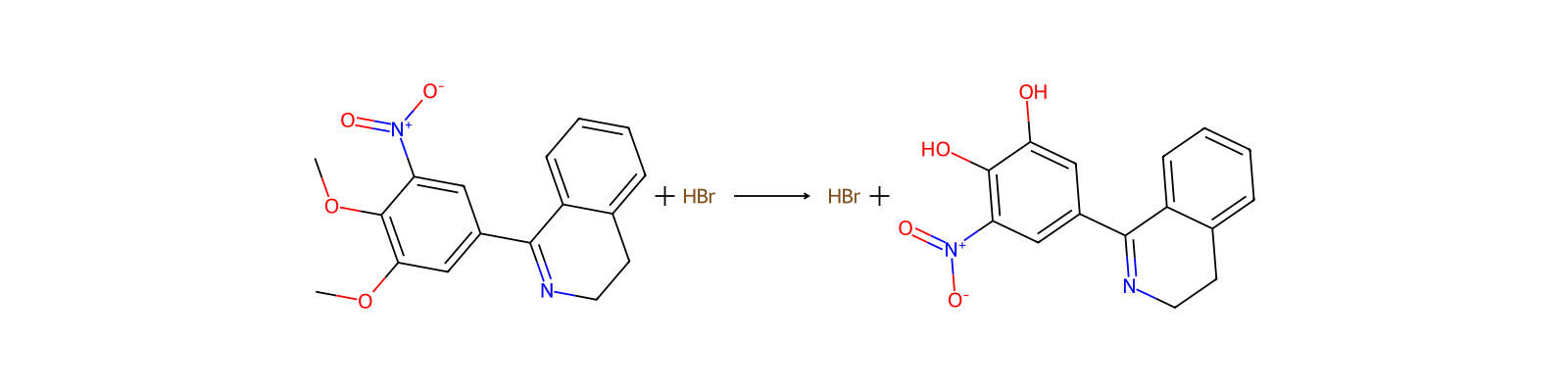
C[O:2][C:3]1[CH:4]=[C:5]([C:14]2[C:23]3[C:18](=[CH:19][CH:20]=[CH:21][CH:22]=3)[CH2:17][CH2:16][N:15]=2)[CH:6]=[C:7]([N+:11]([O-:13])=[O:12])[C:8]=1[O:9]C.[BrH:24]>>[BrH:24].[C:14]1([C:5]2[CH:4]=[C:3]([OH:2])[C:8]([OH:9])=[C:7]([N+:11]([O-:13])=[O:12])[CH:6]=2)[C:23]2[C:18](=[CH:19][CH:20]=[CH:21][CH:22]=2)[CH2:17][CH2:16][N:15]=1Participants
3



Procedure
1.4 g of 1-(3,4-dimethoxy-5-nitrophenyl)-3,4-dihydroisoquinoline are treated with 15 ml of constant-boiling hydrobromic acid and heated to boiling under reflux under a nitrogen atmosphere for 1.5 hours. After distilling the hydrobromic acid in a water-jet vacuum, the crystalline residue is recrystallized from acetone. There is obtained 5-(3,4-dihydro-1-isoquinolinyl)-3-nitropyrocatechol hydrobromide in the form of yellow crystals of m.p. >250° (decomposition).
Workup
- temperatureheated
- temperatureunder reflux under a nitrogen atmosphere for 1.5 hours
- distillationAfter distilling the hydrobromic acid in a water-jet vacuum
- customthe crystalline residue is recrystallized from acetone
Sources & evidence
- ORD record
- ord-1bba47e3c1a447eeb0d356fd6dc35985
- Source dataset
- uspto-grants-1998_01
- Patent number
- US05705703
Reaction notes
Loading…