Acetic Acid → 5,5'-(Hexane-2,5-diylidene)di(cyclopenta-1,3-diene)
Reaction equation

[CH3:1][C:2](=O)[CH2:3][CH2:4][C:5](=O)[CH3:6].[CH:9]1[CH2:13][CH:12]=[CH:11][CH:10]=1.N1[CH2:18][CH2:17][CH2:16][CH2:15]1.[C:19](O)(=O)C>CO.O>[C:10]1(=[C:2]([CH2:3][CH2:4][C:5](=[C:6]2[CH:18]=[CH:17][CH:16]=[CH:15]2)[CH3:19])[CH3:1])[CH:9]=[CH:13][CH:12]=[CH:11]1Participants
7
Reactant 4

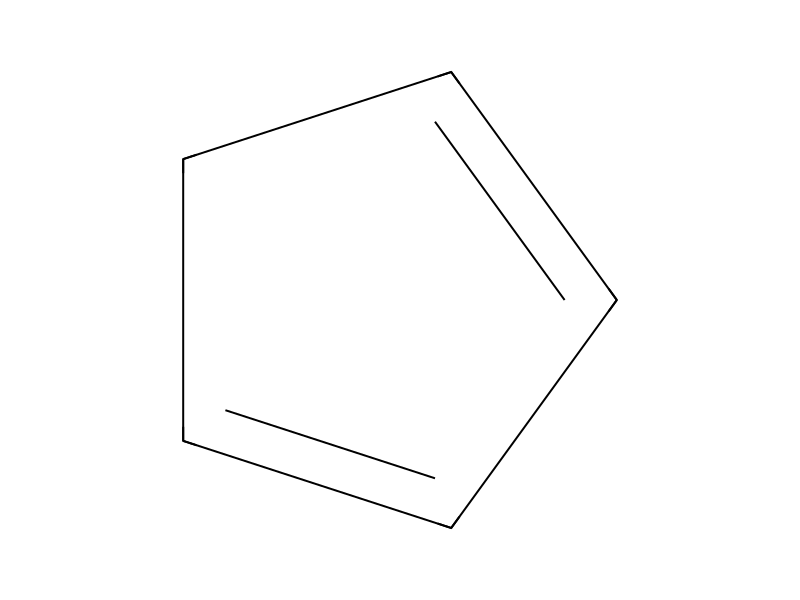


Product 1

Reagents, catalysts & solvents 2


Conditions
- Temperature
- 0 °C
Procedure
In a modified reaction procedure [a], 11.0 g (96.3 mmol) of 2,5-hexanedione and 12.7 g (193 mmol) of freshly cracked cyclopentadiene are dissolved in 60 ml of methanol, the solution is cooled to 0° C., and 8.60 g (121 mmol) of pyrrolidine are added. The reaction solution is stirred at 0° C. for 90 minutes, hydrolyzed using 5 ml of glacial acetic acid and 50 ml of water, and extracted twice with 70 ml of diethyl ether in each case, and the combined organic phases are washed with saturated sodium chloride solution and dried over magnesium sulfate, giving, after removal of the solvent in vacuo, 18.0 g (89%) of the difulvene as an orange-red, oily residue.
Workup
- extractionextracted twice with 70 ml of diethyl ether in each case
- washthe combined organic phases are washed with saturated sodium chloride solution
- dry with materialdried over magnesium sulfate
- customgiving
- customafter removal of the solvent in vacuo, 18.0 g (89%) of the difulvene as an orange-red, oily residue
Sources & evidence
- ORD record
- ord-06b1d13fa96741a394e6f958ea2a4e97
- Source dataset
- uspto-grants-1998_01
- Patent number
- US05710297
Reaction notes
Loading…