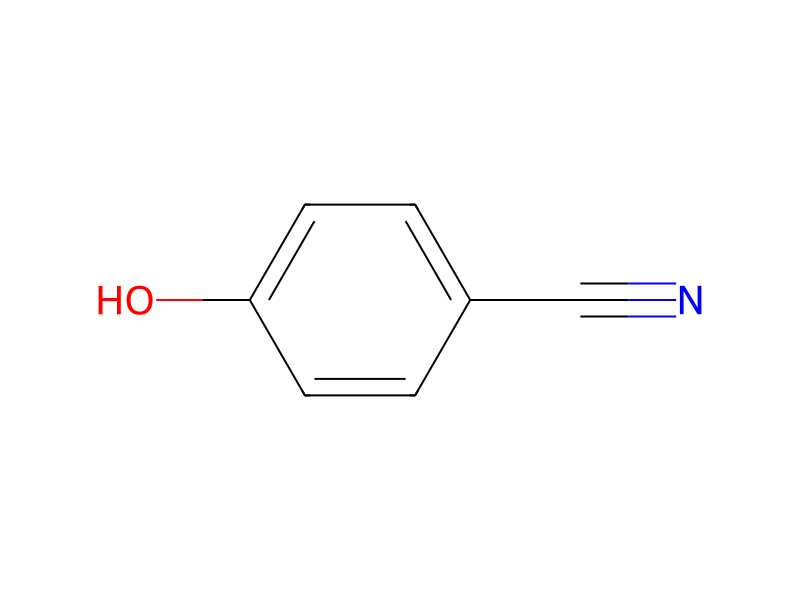
4-Cyanophenol → 4-((5-Chloropentyl)oxy)benzonitrile
Reaction equation

[OH:1][C:2]1[CH:9]=[CH:8][C:5]([C:6]#[N:7])=[CH:4][CH:3]=1.Br[CH2:11][CH2:12][CH2:13][CH2:14][CH2:15][Cl:16]>>[Cl:16][CH2:15][CH2:14][CH2:13][CH2:12][CH2:11][O:1][C:2]1[CH:9]=[CH:8][C:5]([C:6]#[N:7])=[CH:4][CH:3]=1Participants


Procedure
In the fifth step, 4-hydroxy-benzonitrile (7) is reacted with 1-bromo-5-chloropentane, giving 4-(5-chloro-pentoxy)-benzonitrile (8) (yield: 90%). At this time, the reaction temperature is preferably maintained in the range from 20 to 82° C., and the reaction solvent is selected from polar solvents, including dichloromethane, acetonitrile, ethylacetate, lower alcohols such as methanol, ethanol or isopropanol, ethers such as tetrahydrofuran or 1,4-dioxane, dimethylformamide, or dimethylsulfoxide, and mixtures thereof. To ensure that the above reaction occurs under a basic condition, an inorganic base, including potassium carbonate, sodium hydroxide, potassium hydroxide, sodium amide, sodium hydride, sodium methoxide, or sodium ethoxide, and other base, may be used. Subsequently, 4-(5-chloro-pentoxy)-benzonitrile (8) is reacted with iodide, thus preparing 4-(5-iodo-pentoxy)-benzonitrile (9) (yield: 99%). As iodide, sodium iodide may be used.
Sources & evidence
- ORD record
- ord-d505fe9c48224fa3bfa628998e558781
- Source dataset
- uspto-grants-2009_09
- Patent number
- US07585979B2
Reaction notes
Loading…