Pyridine → HCID 23191325, compound
Reaction equation

[OH:1][C:2]1[CH:9]=[CH:8][C:5]([CH:6]=[CH2:7])=[CH:4][CH:3]=1.[CH3:10][O:11][C:12]([CH3:14])=[CH2:13].C1(C)C=CC(S(O)(=O)=O)=CC=1.N1C=CC=CC=1>C(OCC)C.O1CCOCC1>[CH:6]([C:5]1[CH:8]=[CH:9][C:2]([O:1][C:12]([O:11][CH3:10])([CH3:14])[CH3:13])=[CH:3][CH:4]=1)=[CH2:7]Participants
Reactant 4



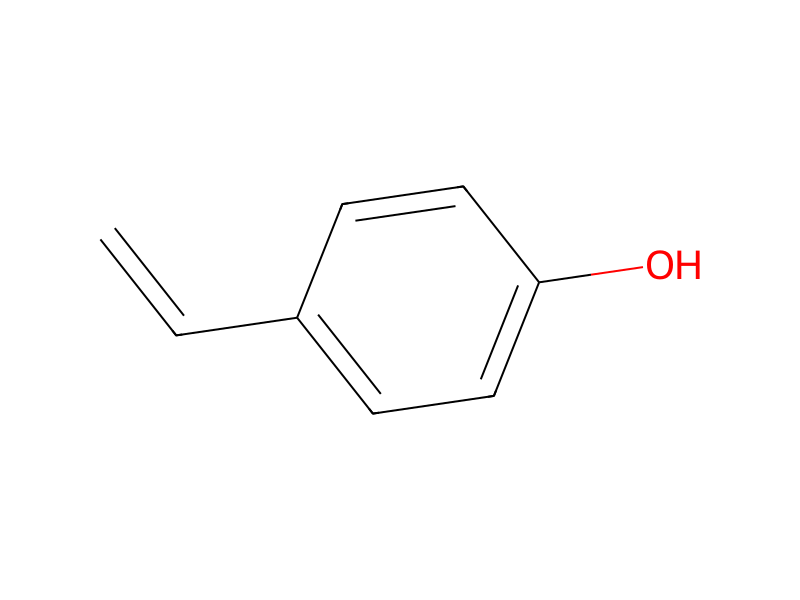
Product 1

Reagents, catalysts & solvents 2


Conditions
- Temperature
- 10 °C
Procedure
72.1 g (600 mmol) of 4-hydroxystyrene are dissolved in a mixture of 300 ml of diethyl ether and 150 ml of dioxane under a nitrogen atmosphere in a 1500 ml sulfonation flask. 216.3 g (3000 mmol) of 2-methoxypropene are added, and the mixture is cooled to 10° C. 1,48 g (7.8 mmol) of p-toluenesulfonic acid in 28.5 g (360 mmol) of pyridine are then added dropwise in the course of 20 minutes, and the mixture is stirred at room temperature for 20 hours. The reaction mixture is washed three times with 300 ml of 0.2N NaOH and three times with 300 ml of demineralized water. The organic phase is dried using magnesium sulfate, filtered through 1 cm of Ambefiyst A27 and evaporated in a rotary evaporator. Further drying of the resultant residue under a high vacuum leaves 99.2 g (82% of theory) of the desired product in the form of a yellow oil.
Workup
- washThe reaction mixture is washed three times with 300 ml of 0.2N NaOH and three times with 300 ml of demineralized water
- customThe organic phase is dried
- filtrationfiltered through 1 cm of Ambefiyst
- customand evaporated in a rotary evaporator
- dry with materialFurther drying of the resultant residue under a high vacuum
Sources & evidence
- ORD record
- ord-e133297cd0d34babbc956fcb6d1fd429
- Source dataset
- uspto-grants-1996_09
- Patent number
- US05558978
Reaction notes
Loading…