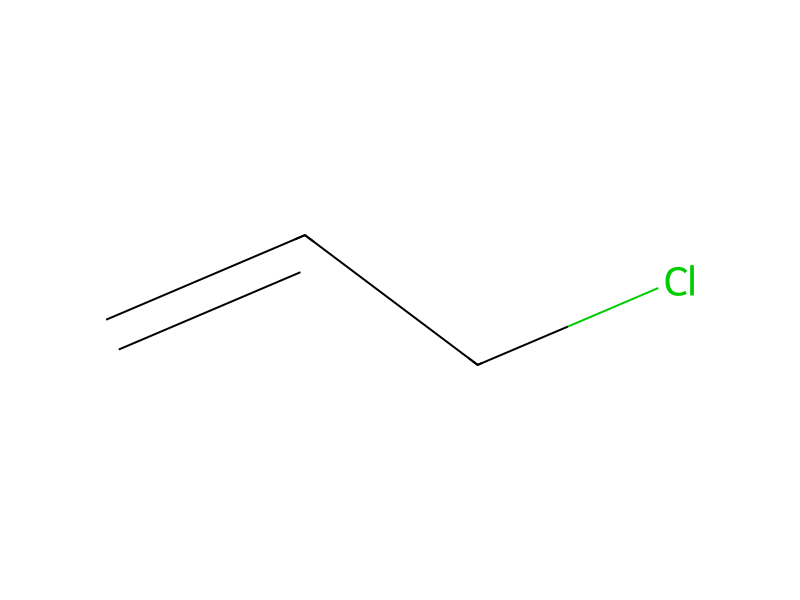
Allyl chloride → 3-(Trimethoxysilyl)propyl chloride
Reaction equation

[CH3:1][O:2][SiH:3]([O:6][CH3:7])[O:4][CH3:5].[CH2:8]([Cl:11])[CH:9]=[CH2:10]>>[Cl:11][CH2:8][CH2:9][CH2:10][Si:3]([O:6][CH3:7])([O:4][CH3:5])[O:2][CH3:1]Participants


Procedure
The same researchers also report the results of directly hydrosilating allyl chloride with trimethoxysilane in the presence of several ruthenium complexes. A maximum yield of 73.6% of chloropropyltrimethoxysilane is reported in Table 2 for the reaction between trimethoxysilane and allyl chloride at a 4/l molar ratio. Assuming the use of the "typical reaction procedure," the process may have employed a ruthenium carbonyl catalyst in an amount to provide at least about 155 parts per million by weight of ruthenium metal in the reaction mixture. Apparently, the reaction also was conducted in a sealed reactor under autogenous pressure in the presence of at least 13.3% by weight of toluene solvent for 16 hours at 80° C. The conversion of limiting allyl chloride was complete, and thus the yields of by-products such as propyltrimethoxysilane, tetramethoxysilane and hydrogen, were not insignificant. The same reaction, at a 2/1 molar ratio of trimethoxysilane to allyl chloride, in the presence of the same absolute weights of ruthenium catalyst and toluene solvent, provided a 72.2% yield of chloropropyltrimethoxysilane on a molar basis, with similar by-product yields at complete conversion of limiting allyl chloride. At a 1/1 molar ratio, the conversion of allyl chloride was not complete. At this mole ratio, a maximum yield of only 52.4% was obtained after 16 hours at 50° C., while at 80° C. the yield was only 26.4%. (Table 2).
Sources & evidence
- ORD record
- ord-786e4f7da3964398aa5e91f1527434b4
- Source dataset
- uspto-grants-1996_09
- Patent number
- US05559264
Reaction notes
Loading…