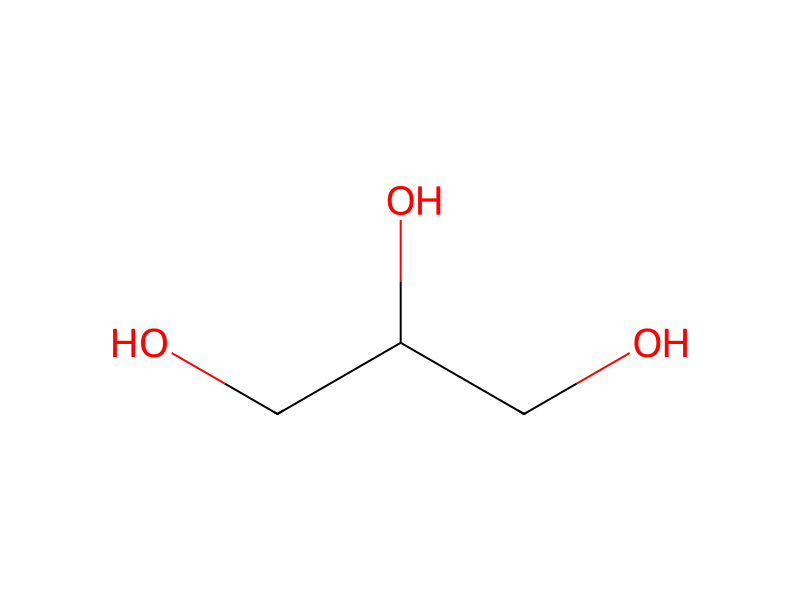
Glycerol → 3-Trityloxypropane-1,2-diol
Reaction equation

[OH:1][CH2:2][CH:3]([CH2:5][OH:6])[OH:4].[C:7]1([C:13]([C:21]2[CH:26]=[CH:25][CH:24]=[CH:23][CH:22]=2)([C:15]2[CH:20]=[CH:19][CH:18]=[CH:17][CH:16]=2)Cl)[CH:12]=[CH:11][CH:10]=[CH:9][CH:8]=1.O>N1C=CC=CC=1>[OH:1][CH2:2][CH:3]([OH:4])[CH2:5][O:6][C:13]([C:7]1[CH:12]=[CH:11][CH:10]=[CH:9][CH:8]=1)([C:21]1[CH:22]=[CH:23][CH:24]=[CH:25][CH:26]=1)[C:15]1[CH:16]=[CH:17][CH:18]=[CH:19][CH:20]=1Participants
Reactant 3


Product 1

Reagents, catalysts & solvents 1

Procedure
Glycerol (3.02 g, 32.8 mmol) (Wako Pure Chemical Industries, Ltd.) and triphenylchloromethane (1.00 g, 3.50 mmol) (Wako Pure Chemical Industries, Ltd.) were dissolved in pyridine (20 mL) (Wako Pure Chemical Industries, Ltd.), and the mixture was refluxed for 5 hours. The mixture was allowed to cool to room temperature, and then water was added thereto, followed by extraction with ethyl acetate (Wako Pure Chemical Industries, Ltd.). The organic layer was dried with anhydrous sodium sulfate (Wako Pure Chemical Industries, Ltd.), and the solvent was distilled off under reduced pressure. The residue was subjected to silica gel column chromatography (chloroform (Wako Pure Chemical Industries, Ltd.):methanol (Wako Pure Chemical Industries, Ltd.)=97:3), to thereby obtain the title compound (0.50 g, 42% yield).
Workup
- temperaturethe mixture was refluxed for 5 hours
- extractionfollowed by extraction with ethyl acetate (Wako Pure Chemical Industries, Ltd.)
- dry with materialThe organic layer was dried with anhydrous sodium sulfate (Wako Pure Chemical Industries, Ltd.)
- distillationthe solvent was distilled off under reduced pressure
Sources & evidence
- ORD record
- ord-5cdf62e5d81f4686b4da3b3a65a49966
- Source dataset
- uspto-grants-2014_09
- Patent number
- US08846012B2
Reaction notes
Loading…