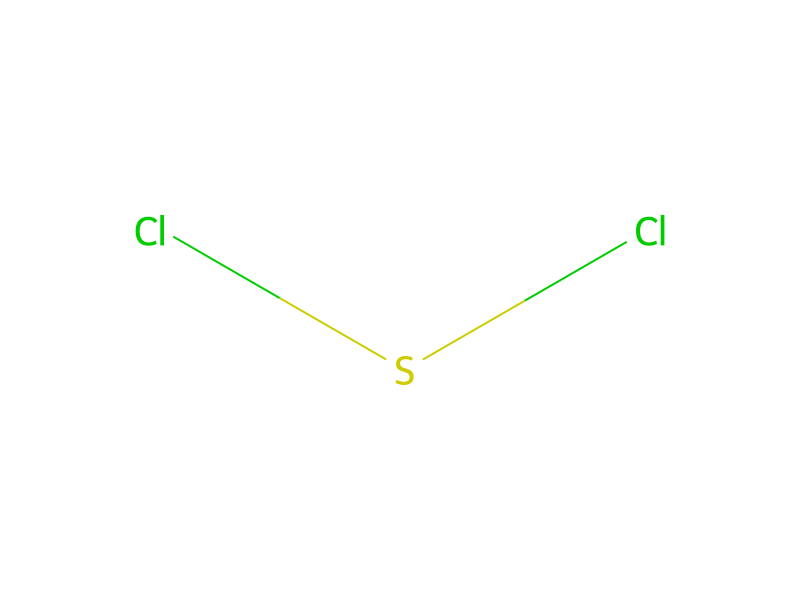
Sulfur dichloride → HCID 11021483, compound
Reaction equation

[CH2:1]([S:8][C:9](=[S:15])[NH:10][CH2:11][C:12](Cl)=[CH2:13])[C:2]1[CH:7]=[CH:6][CH:5]=[CH:4][CH:3]=1.C(=O)([O-])O.[Na+].S(Cl)[Cl:22]>ClCCl>[CH2:1]([S:8][C:9]1[S:15][C:12]([CH2:13][Cl:22])=[CH:11][N:10]=1)[C:2]1[CH:7]=[CH:6][CH:5]=[CH:4][CH:3]=1Participants
Reactant 3


Product 1

Reagents, catalysts & solvents 1

Procedure
5.0 g of (2-chloro-allyl)-dithiocarbamic acid benzyl ester and 4.1 g of sodium hydrogen carbonate are placed in 100 ml of dichloromethane and cooled in an ice bath. In the course of 3 minutes, a solution of 3.2 g of sulfur chloride in 10 ml of dichloromethane is added, and when the addition is complete the ice bath is removed. The mixture is stirred at room temperature for 2 hours and filtered off with suction, and the filtrate is concentrated by evaporation. The residue crystallises after the addition of diethyl ether. Filtration yields 2-benzylsulfanyl-5-chloromethyl-thiazole having a melting point of 129-131° C. in the form of the hydrochloride. Extraction of the mother liquor with semi-saturated aqueous sodium hydrogen carbonate solution and removal of the ether by distillation yield 2-benzylsulfanyl-5-chloromethyl-thiazole having a melting point of 57-61° C.
Workup
- temperaturecooled in an ice bath
- additionwhen the addition
- customis removed
- filtrationfiltered off with suction
- concentrationthe filtrate is concentrated by evaporation
- customThe residue crystallises
- additionafter the addition of diethyl ether
- filtrationFiltration
Sources & evidence
- ORD record
- ord-dbba9a1d81344deeab97ba0b1ff4da27
- Source dataset
- uspto-grants-2002_04
- Patent number
- US06369233B1
Reaction notes
Loading…