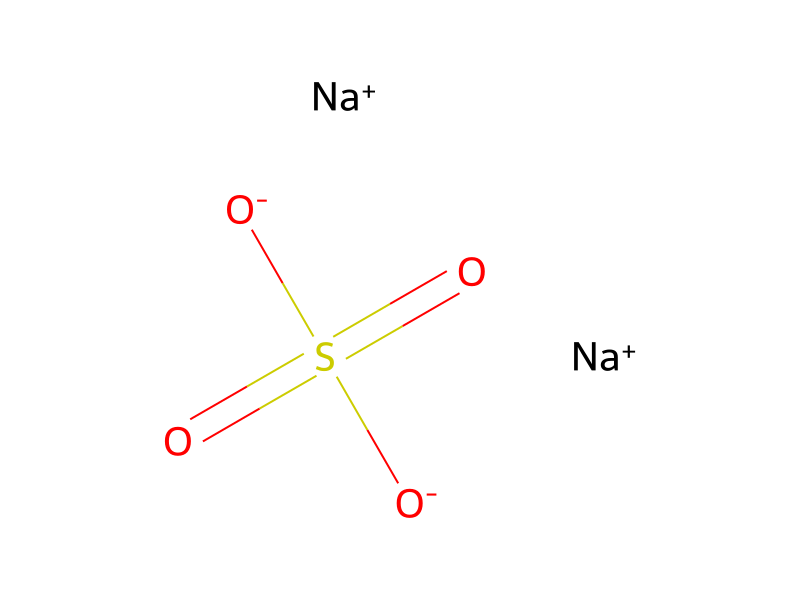
Sodium Sulfate → tert-Butyl 2-(3-aminoquinolin-4-ylamino)ethylcarbamate
Reaction equation

S([O-])([O-])(=O)=O.[Na+].[Na+].[N+:8]([C:11]1[CH:12]=[N:13][C:14]2[C:19]([C:20]=1[NH:21][CH2:22][CH2:23][NH:24][C:25](=[O:31])[O:26][C:27]([CH3:30])([CH3:29])[CH3:28])=[CH:18][CH:17]=[CH:16][CH:15]=2)([O-])=O.[H][H]>[Pt].C1(C)C=CC=CC=1>[NH2:8][C:11]1[CH:12]=[N:13][C:14]2[C:19]([C:20]=1[NH:21][CH2:22][CH2:23][NH:24][C:25](=[O:31])[O:26][C:27]([CH3:29])([CH3:28])[CH3:30])=[CH:18][CH:17]=[CH:16][CH:15]=2Participants
6
Reactant 3


Product 1

Reagents, catalysts & solvents 2


Procedure
Platinum on carbon (1.0 g of 10%) and sodium sulfate (2 g) were added to a slurry of 1,1-dimethylethyl N-{2-[(3-nitroquinolin-4-yl)amino]ethyl}carbamate (100 g, 0.30 mol) in toluene (500 mL). The reaction vessel was placed on a Parr apparatus under 50 psi (3.5 Kg/cm2) hydrogen pressure overnight at ambient temperature. The reaction mixture was filtered through a layer of Celite® filter aid to remove the catalyst. The filtrate was concentrated under vacuum to provide 73 g of 1,1-dimethylethyl N-{2-[(3-aminoquinolin-4-yl)amino]ethyl}carbamate as a dark gold oil. Thin layer chromatography (silica gel; 10% methanol in dichloromethane) analysis indicated that the material was pure.
Workup
- filtrationThe reaction mixture was filtered through a layer of Celite®
- filtrationfilter aid
- customto remove the catalyst
- concentrationThe filtrate was concentrated under vacuum
Sources & evidence
- ORD record
- ord-e7e8abcf38fb47e0a17fee7ddb7dfc9f
- Source dataset
- uspto-grants-2002_04
- Patent number
- US06376669B1
Reaction notes
Loading…