2,5-Dichloroaniline → HCID 9888577, compound
Reaction equation

[Cl:1][C:2]1[CH:8]=[CH:7][C:6]([Cl:9])=[CH:5][C:3]=1[NH2:4].[C:10](N1C=CN=C1)(N1C=CN=C1)=[S:11].[NH2:22][C:23]1[CH:28]=[CH:27][C:26]([NH:29][C:30]([C:32]2[N:33]=[N:34][S:35][CH:36]=2)=[O:31])=[CH:25][CH:24]=1>O1CCCC1>[Cl:1][C:2]1[CH:8]=[CH:7][C:6]([Cl:9])=[CH:5][C:3]=1[NH:4][C:10](=[S:11])[NH:22][C:23]1[CH:24]=[CH:25][C:26]([NH:29][C:30]([C:32]2[N:33]=[N:34][S:35][CH:36]=2)=[O:31])=[CH:27][CH:28]=1Participants
5
Reactant 3

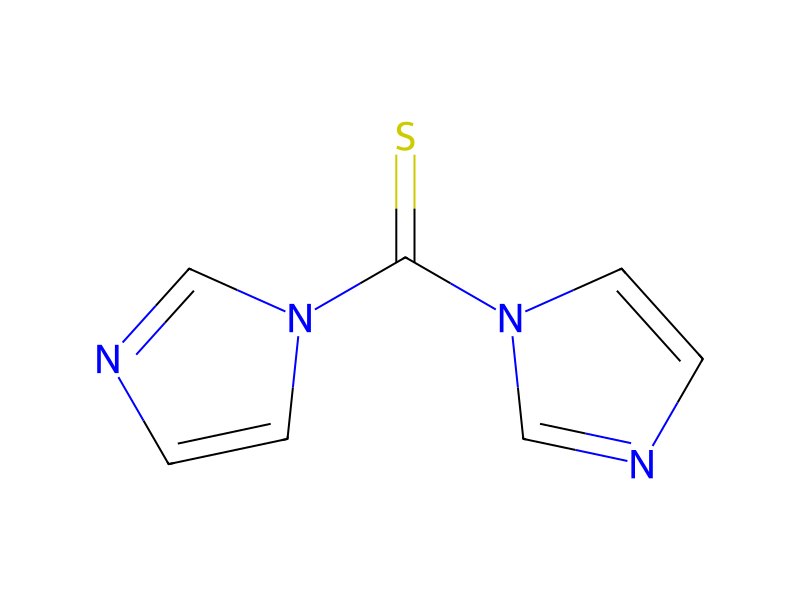

Product 1

Reagents, catalysts & solvents 1

Procedure
To a solution of 2,5-dichloroaniline (0.16 g) in tetrahydrofuran (20 mL) is added freshly prepared 1,1′-thiocarbonyldiimidazole (0.20 g) and the mixture is stirred for approximately 30 minutes at room temperature. [1,2,3]-Thiadiazole-4-carboxylic acid (4-amino-phenyl) amide (0.22 g) is added to the reaction flask and the mixture is stirred for approximately 6 hours. The solvent is then removed by evaporation under reduce pressure and warm acetonitrile (3 mL) is added. After 15 hours the mixture is filtered and the collected precipitate is washed with acetonitrile then diethyl ether, and air dried to provide the desired product as a white powder.
Workup
- stirringthe mixture is stirred for approximately 6 hours
- customThe solvent is then removed by evaporation
- temperaturewarm acetonitrile (3 mL)
- additionis added
- filtrationAfter 15 hours the mixture is filtered
- washthe collected precipitate is washed with acetonitrile
- dry with materialdiethyl ether, and air dried
Sources & evidence
- ORD record
- ord-3172a068aa2948849dcb103e1eaa5bda
- Source dataset
- uspto-grants-2002_04
- Patent number
- US06380243B1
Reaction notes
Loading…