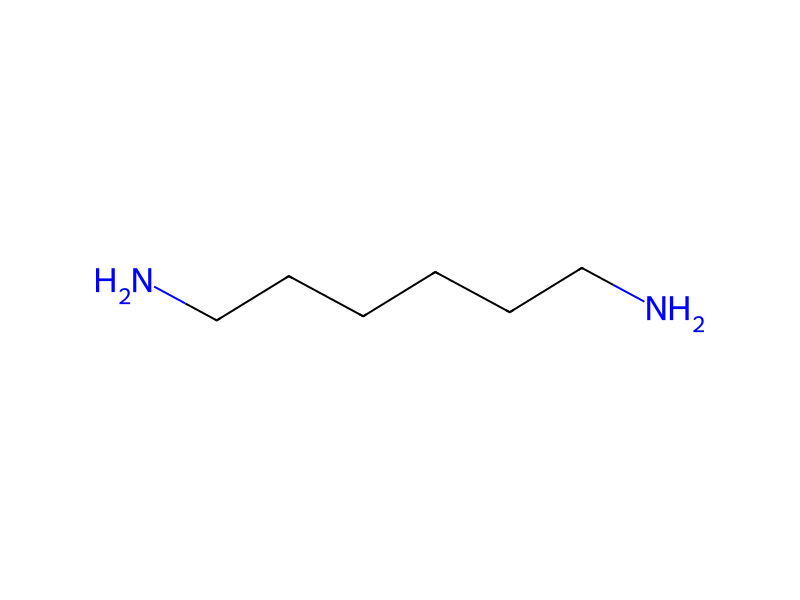
Ammonia → Hexamethylenediamine
Reaction equation

[CH2:1]([CH2:6][C:7]#[N:8])[CH2:2][CH2:3][C:4]#[N:5].[NH3:9]>>[NH:8]1[CH2:4][CH2:3][CH2:2][CH2:1][CH2:6][CH2:7]1.[CH2:1]([CH2:6][CH2:7][NH2:8])[CH2:2][CH2:3][CH2:4][NH:5][CH2:7][CH2:6][CH2:1][CH2:2][CH2:3][CH2:4][NH2:9].[CH2:4]([NH2:5])[CH2:3][CH2:2][CH2:1][CH2:6][CH3:7].[NH2:5][CH2:4][CH2:3][CH2:2][CH2:1][CH2:6][CH2:7][NH2:8]Participants
6


Procedure
0.4 liter/hour of adipodinitrile, 1.2 liter/hour of ammonia and 2.4 liters/hour of hydrogenation mixture are fed, at 270° C. and under an H2 pressure of 260 bar, into the reactor described in Example 1, and over the catalyst described in that Example. Azacycloheptane is obtained in a yield of 70% together with 3% of bishexamethylenetriamine, 7% of hexylamine and 15% of hexamethylenediamine.
Workup
- customare fed, at 270° C. and under an H2
Sources & evidence
- ORD record
- ord-441f141ba45e4f95b313919dfdf2a133
- Source dataset
- uspto-grants-1988_07
- Patent number
- US04755604
Reaction notes
Loading…