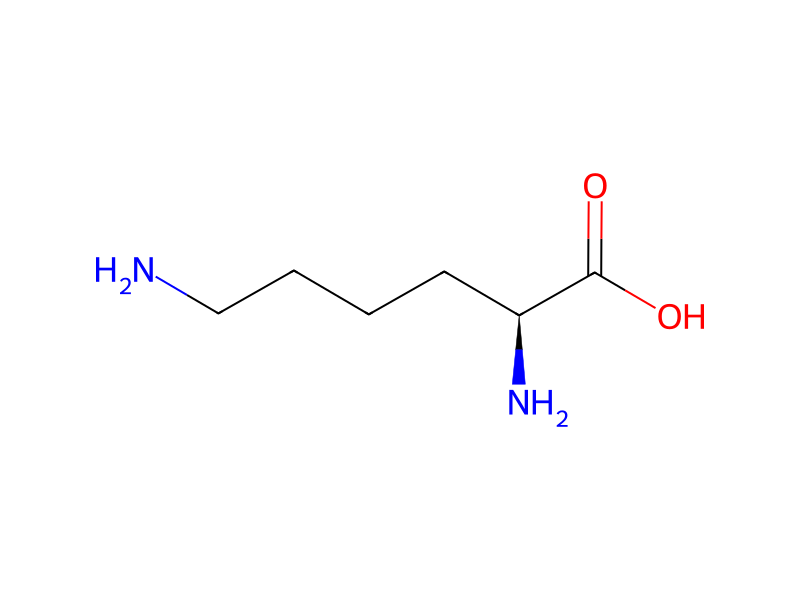
L-Homoserine → L-Lysine
Reaction equation

[NH2:1][C@H:2]([C:6]([OH:8])=[O:7])[CH2:3][CH2:4]O.C[CH:10](OC1C=CC=CC=1)[C:11]([NH:13][C@@H]1C(=O)N2[C@@H](C(O)=O)C(C)(C)S[C@H]12)=O>>[NH2:1][C@H:2]([C:6]([OH:8])=[O:7])[CH2:3][CH2:4][CH2:10][CH2:11][NH2:13]Participants
Reactant 2


Product 1
Procedure
Plasmid pAJ 201 was introduced into Brevibacterium lactofermentum AJ 12019 (NRRL B-15346) (auxotrophy for homoserine) by the transformation method described in (4). The results obtained by examination of lysine productivity with the thus-obtained transformant AJ 12073 (FERM-P 7205) are shown in Table 3. The cultivation was carried out by charging in a shoulder-equipped flask 20 ml of medium containing 10 g/dl of glucose, 5.5 g/dl of ammonium sulfate, 0.1 g/dl of KH2PO4, 0.1 g/dl of MgSO4 . 0.001 g/dl of FeSO4 . 4H2O, 0,001 g/dl of MnSo4 . 4H2 0, 200 μg/l of thiamine hydrochloride, 2.5 mg/dl of nicotinamide, 105 mg/dl of soybean protein hydrolysate (as total nitrogen), and 5 g/dl of calcium carbonate, the pH of which had been adjusted to 8.0, while shaking at 31.5° C. for 72 hours. After completion of the cultivation, lysine in the culture liquid was quantitatively determined with high speed liquid chromatography.
Sources & evidence
- ORD record
- ord-2724ea36a0d5442f8a245b4ac88b4e6b
- Source dataset
- uspto-grants-1988_07
- Patent number
- US04757009
Reaction notes
Loading…