Diphosgene → HCID 10998791, compound
Reaction equation

[F:1][C:2]([F:13])([F:12])[C:3]1[S:4][C:5]([C:9](O)=[O:10])=[C:6]([CH3:8])[N:7]=1.[Cl:14]C(OC(Cl)(Cl)Cl)=O>ClC1C=CC=CC=1.N1C=CC=CC=1>[F:1][C:2]([F:13])([F:12])[C:3]1[S:4][C:5]([C:9]([Cl:14])=[O:10])=[C:6]([CH3:8])[N:7]=1Participants
5
Reactant 2
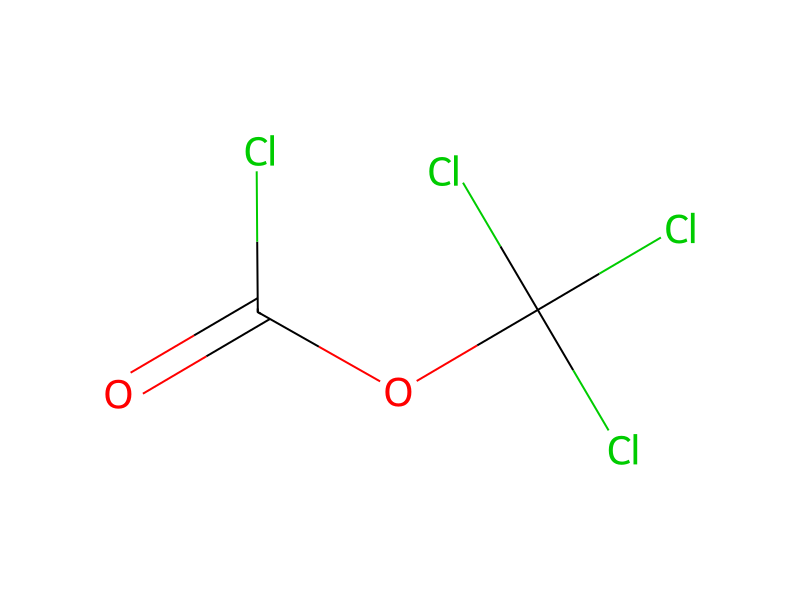

Product 1

Reagents, catalysts & solvents 2


Procedure
In a similar apparatus to Example 1, 4.2 g (0.02 mole) of 2-trifluoromethyl-4-methylthiazole-5-carboxylic acid were suspended in 100 ml of chlorobenzene, followed by the addition of 0.04 g of pyridine. Under heating and reflux, 9.9 g (0.05 mole) of trichloromethyl chloroformate were added dropwise over 5 hours. After completion of the dropwise addition, stirring was continued for additional 2 hours. After completion of the reaction, the reaction mixture was filtered and the filtrate was concentrated to obtain 4.5 g of 2-trifluoromethyl-4-methylthiazole-5-carboxylic acid chloride. Its purity and yield were 98.7% and 98.0%, respectively.
Workup
- temperatureUnder heating
- temperaturereflux
- additionAfter completion of the dropwise addition
- customAfter completion of the reaction
- filtrationthe reaction mixture was filtered
- concentrationthe filtrate was concentrated
Sources & evidence
- ORD record
- ord-2bdc6714dcb7439ba6c6637e0ccccbfb
- Source dataset
- uspto-grants-1992_08
- Patent number
- US05136042
Reaction notes
Loading…