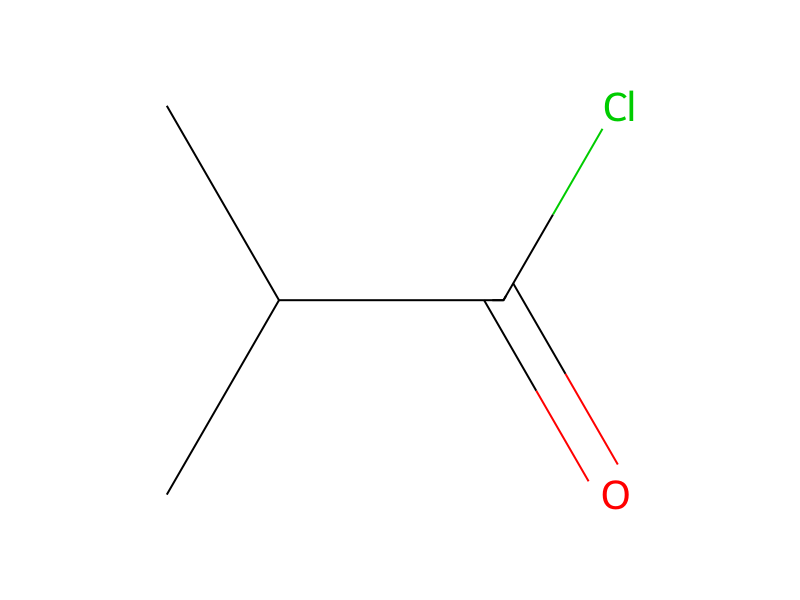
Isobutyryl chloride → N-(5-t-butyl-3-isoxazolyl)isobutyramide
Reaction equation

[NH2:1][C:2]1[CH:6]=[C:5]([C:7]([CH3:10])([CH3:9])[CH3:8])[O:4][N:3]=1.[C:11](Cl)(=[O:15])[CH:12]([CH3:14])[CH3:13]>N1C=CC=CC=1>[C:7]([C:5]1[O:4][N:3]=[C:2]([NH:1][C:11](=[O:15])[CH:12]([CH3:14])[CH3:13])[CH:6]=1)([CH3:10])([CH3:9])[CH3:8]Participants
Reactant 2

Product 1

Reagents, catalysts & solvents 1

Procedure
To a solution of 3-amino-5-t-butylisoxazole (2.80 g) in pyridine (10 ml) is dropwise added isobutyryl chloride (2.34 g) keeping the mixture below 10° C. The reaction mixture is stirred with cooling for 30 minutes and at room temperature for 1 hour and evaporated to remove the pyridine. The residue is mixed with 5% hydrochloric acid solution (40 ml) and shaken with methylene chloride. The methylene chloride layer is separated, washed with saturated aqueous sodium hydrogen carbonate and water, dried over anhydrous sodium sulfate and evaporated to remove the methylene chloride. The residue is chromatographed on a column of silica gel and recrystallized from n-hexane to give N-(5-t-butyl-3-isoxazolyl)isobutyramide (3.85 g) as colorless needles melting at 123.0° to 124.0° C.
Workup
- customthe mixture below 10° C
- customevaporated
- customto remove the pyridine
- additionThe residue is mixed with 5% hydrochloric acid solution (40 ml)
- stirringshaken with methylene chloride
- customThe methylene chloride layer is separated
- washwashed with saturated aqueous sodium hydrogen carbonate and water
- dry with materialdried over anhydrous sodium sulfate
- customevaporated
- customto remove the methylene chloride
- customThe residue is chromatographed on a column of silica gel
- customrecrystallized from n-hexane
Sources & evidence
- ORD record
- ord-b48792f085f5446ab6ee7d03729abadf
- Source dataset
- uspto-grants-1981_10
- Patent number
- US04293328
Reaction notes
Loading…