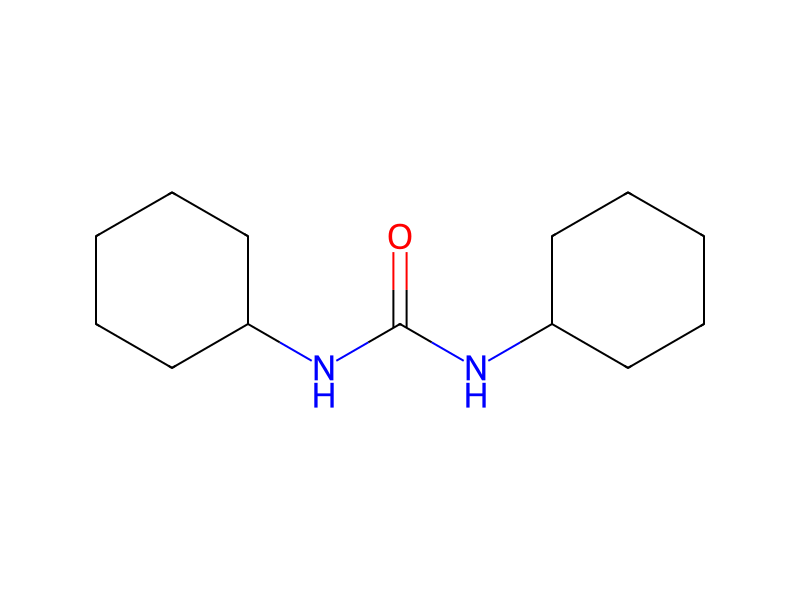
Phenol → N,N'-Dicyclohexylurea
Reaction equation

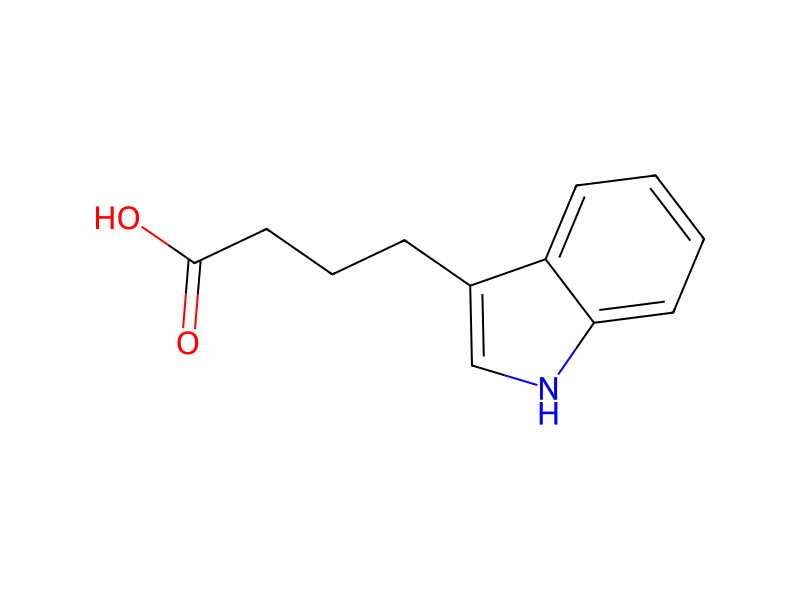
C1([OH:7])C=CC=CC=1.[CH:8]1([N:14]=[C:15]=[N:16][CH:17]2[CH2:22][CH2:21][CH2:20][CH2:19][CH2:18]2)[CH2:13][CH2:12][CH2:11][CH2:10][CH2:9]1.N1C2C(=CC=CC=2)C(CCCC(O)=O)=C1>O1CCCC1>[C:15]([NH:14][CH:8]1[CH2:9][CH2:10][CH2:11][CH2:12][CH2:13]1)([NH:16][CH:17]1[CH2:22][CH2:21][CH2:20][CH2:19][CH2:18]1)=[O:7]Participants
5
Reactant 3


Product 1
Reagents, catalysts & solvents 1

Conditions
- Temperature
- 0 °C
Procedure
Phenol (0.46 g., 0.005 mole), dicyclohexylcarbodiimide (1.01 g, 0.005 mole) and indole-3-butyric acid (1.00 gm. 0.005 mole) were dissolved in minimal amounts of tetrahydrofuran in individual glass-stoppered Erlenmeyer flasks. Indole-3-butyric acid and dicyclohexylcarbodiimde solutions were mixed together and allowed to react for 15 minutes. The phenol solution was then added and the mixture allowed to react for 48 hours at room temperature. The mixture was then cooled in a refrigerator (0° C.). Dicyclohexylurea crystals which formed were filtered, washed with cold tetrahydrofuran, and the filtrate reduced in volume. Filtration, washing, and volume reduction were repeated four times.
Workup
- customto react for 15 minutes
- customto react for 48 hours at room temperature
Sources & evidence
- ORD record
- ord-0d1a3462983c4bd99ab2d0a56e2b9fe0
- Source dataset
- uspto-grants-1981_10
- Patent number
- US04297125
Reaction notes
Loading…