4-Nitrophenol → N,N'-Dicyclohexylurea
Reaction equation

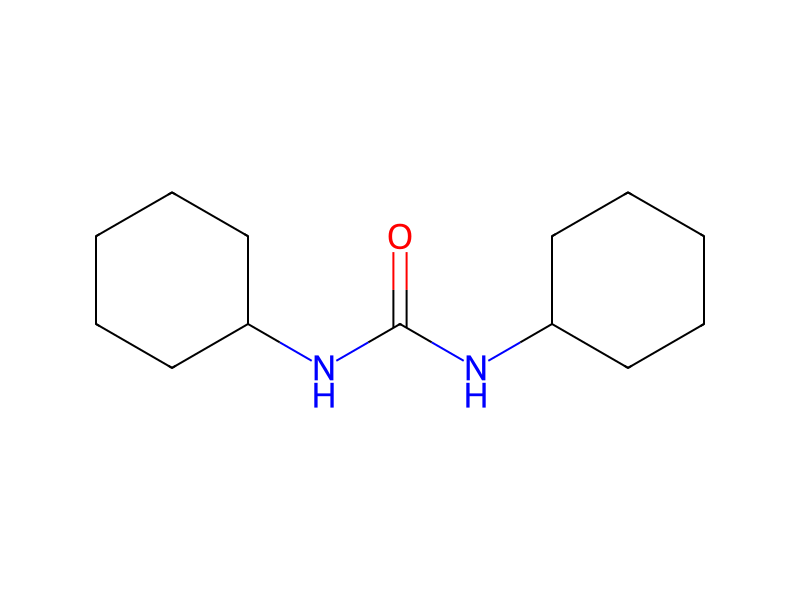
C1C([N+]([O-])=[O:8])=CC=C(O)C=1.[CH:11]1([N:17]=[C:18]=[N:19][CH:20]2[CH2:25][CH2:24][CH2:23][CH2:22][CH2:21]2)[CH2:16][CH2:15][CH2:14][CH2:13][CH2:12]1>C(OCC)(=O)C>[C:18]([NH:17][CH:11]1[CH2:12][CH2:13][CH2:14][CH2:15][CH2:16]1)([NH:19][CH:20]1[CH2:25][CH2:24][CH2:23][CH2:22][CH2:21]1)=[O:8]Participants
4
Reactant 2


Product 1
Reagents, catalysts & solvents 1

Conditions
- Temperature
- -5 °C
Procedure
The above product (0.75 g, 0.0024 mole) is dissolved in 50 ml ethyl acetate. This is cooled to -5° C. and p-nitrophenol is added followed by the portionwise addition of dicyclohexylcarbodiimide. The reaction mixture is stirred at -5° C. for 2 hours. The formed dicyclohexylurea is filtered off. After concentrating to a 10 ml volume, the reaction mixture is cooled overnight. More dicyclohexylurea is formed. This is filtered and the filtrate is concentrated in vacuo to yield 0.95 g of active ester, (the p-nitrophenyl ester of N-[N-[2-(mercaptomethyl)-4-methyl-1-oxopentyl]glycyl]glycine).
Workup
- filtrationThe formed dicyclohexylurea is filtered off
- concentrationAfter concentrating to a 10 ml volume
- temperaturethe reaction mixture is cooled overnight
Sources & evidence
- ORD record
- ord-b703f12356ab44b2bcafcaa901fa4629
- Source dataset
- uspto-grants-1983_05
- Patent number
- US04382081
Reaction notes
Loading…