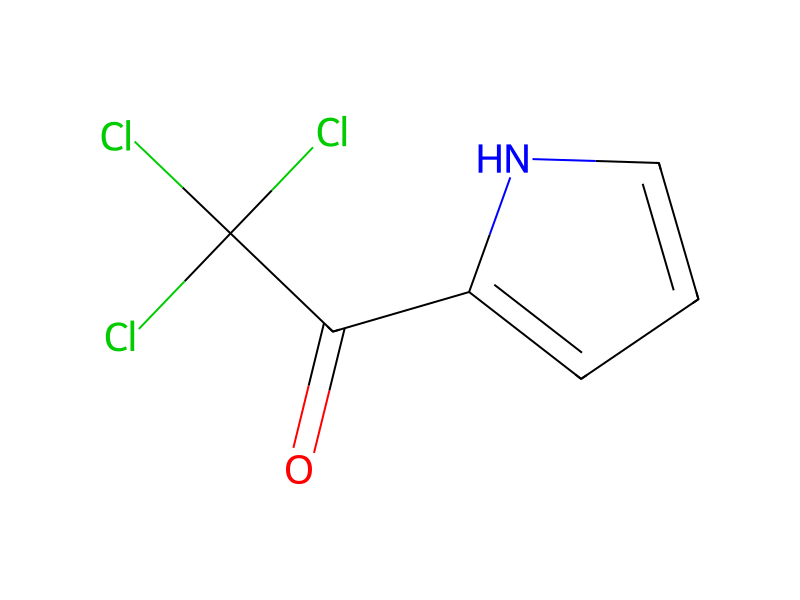
2-(Trichloroacetyl)pyrrole → 2,2,2-Trichloro-1-(4-(3-Chlorophenyl) acetyl-1H-pyrrol-2-yl)-ethanone
Reaction equation

[Cl:1][C:2]1[CH:3]=[C:4]([CH2:8][C:9](Cl)=[O:10])[CH:5]=[CH:6][CH:7]=1.[Cl:12][C:13]([Cl:22])([Cl:21])[C:14]([C:16]1[NH:17][CH:18]=[CH:19][CH:20]=1)=[O:15].[Cl-].[Cl-].[Cl-].[Al+3]>ClCCl>[Cl:22][C:13]([Cl:12])([Cl:21])[C:14]([C:16]1[NH:17][CH:18]=[C:19]([C:9](=[O:10])[CH2:8][C:4]2[CH:5]=[CH:6][CH:7]=[C:2]([Cl:1])[CH:3]=2)[CH:20]=1)=[O:15]Participants
5




Procedure
In a dry flask, 3-chlorophenylacetyl chloride (1 equivalent) was combined with 2-trichloroacetyl pyrrole (1 equivalent) in a minimum amount of dichloromethane (DCM). To the resulting solution, at ambient temperature, was added aluminum trichloride (1 equivalent). After 2 hours, the reaction mixture was applied directly onto a silica gel column. Gradient elution with 10% ethyl acetate to 50% ethyl acetate in hexanes provided compound 2. HPLC using method A provided Rt of 15 minutes
Workup
- washGradient elution with 10% ethyl acetate to 50% ethyl acetate in hexanes provided compound 2
Sources & evidence
- ORD record
- ord-2e75b18f538d4e09ad5e216d42ee87cc
- Source dataset
- uspto-grants-2007_08
- Patent number
- US07253187B2
Reaction notes
Loading…