N-methyl-2-pyrrolidone → 1-(2-Chloro-4,5-difluorobenzoyl)-3-(5-amino-2-methoxyphenyl)urea
Reaction equation
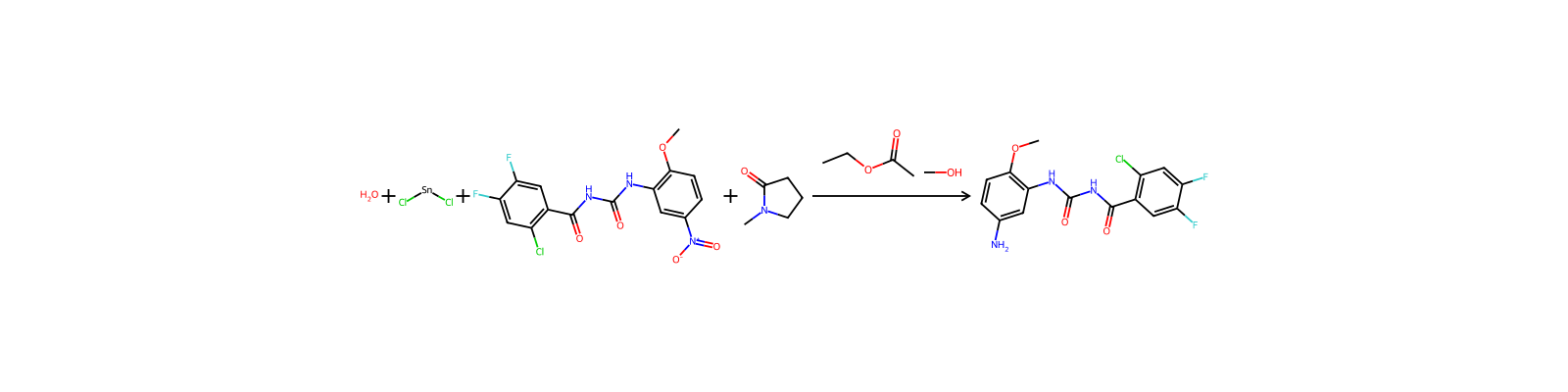
O.[Sn](Cl)Cl.[Cl:5][C:6]1[CH:28]=[C:27]([F:29])[C:26]([F:30])=[CH:25][C:7]=1[C:8]([NH:10][C:11]([NH:13][C:14]1[CH:19]=[C:18]([N+:20]([O-])=O)[CH:17]=[CH:16][C:15]=1[O:23][CH3:24])=[O:12])=[O:9].CN1CCCC1=O>C(OCC)(=O)C.CO>[NH2:20][C:18]1[CH:17]=[CH:16][C:15]([O:23][CH3:24])=[C:14]([NH:13][C:11]([NH:10][C:8](=[O:9])[C:7]2[CH:25]=[C:26]([F:30])[C:27]([F:29])=[CH:28][C:6]=2[Cl:5])=[O:12])[CH:19]=1Participants
5
Reactant 3



Product 1

Reagents, catalysts & solvents 1

Procedure
5.8 g (25.9 mmol) of tin dichloride hydrate were added to 2.0 g (5.2 mmol) of 1-(2-chloro-4,5-difluorobenzoyl)-3-(2-methoxy-5-nitrophenyl)urea in 20 ml of ethyl acetate/methanol mixture at 70° C. After 1 hour, 30 ml of N-methyl-2-pyrrolidinone were added, and the mixture was stirred for a further 2 hours. After cooling, the reaction mixture was made basic and the resulting precipitate was filtered off with suction. The phases were separated. The organic phase was then washed three times with water, dried and concentrated under high vacuum. 1.2 g (67%) of the desired product were obtained.
Workup
- temperatureAfter cooling
- filtrationthe resulting precipitate was filtered off with suction
- customThe phases were separated
- washThe organic phase was then washed three times with water
- customdried
- concentrationconcentrated under high vacuum
Sources & evidence
- ORD record
- ord-2d612515089a4fb6a70706178edffb3f
- Source dataset
- uspto-grants-2007_08
- Patent number
- US07262220B2
Reaction notes
Loading…