Sodium Hydroxide → 2-Chloro-4-nitrobenzene-1-thiol
Reaction equation

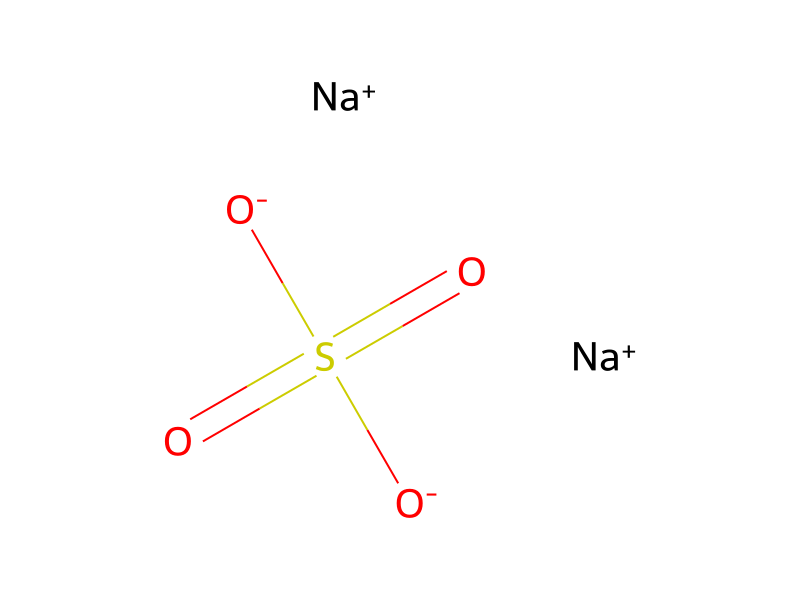
[Cl:1][C:2]1[CH:7]=[C:6]([N+:8]([O-:10])=[O:9])[CH:5]=[CH:4][C:3]=1Br.[S:12]([O-])([O-])(=O)=O.[Na+].[Na+].[S].[OH-].[Na+]>C(O)C>[Cl:1][C:2]1[CH:7]=[C:6]([N+:8]([O-:10])=[O:9])[CH:5]=[CH:4][C:3]=1[SH:12]Participants
6
Reactant 4



Product 1

Reagents, catalysts & solvents 1

Procedure
2-chloro-4-nitro-bromobenzene (20 g) was dissolved in ethanol (160 ml), and an aqueous solution of sodium sulfate nanohydrate (15.2 g) and sulfur (2.0 g) in ethanol (200 ml) was added dropwise to the solution for 20 minutes under heat reflux. An aqueous solution of sodium hydroxide (5.1 g, 20.3 ml) was added dropwise to the solution for 20 minutes, and then, the mixture was cooled to room temperature, and ice-water was added thereto. The precipitates were filtered, and the pH of the filtrate was adjusted to about pH 5 with 6N hydrochloric acid, and the precipitates were collected by filtration and washed with water to give 2-chloro-4-nitrobenzenethiol (9.4 g).
Workup
- temperatureunder heat
- temperaturereflux
- filtrationThe precipitates were filtered
- filtrationthe precipitates were collected by filtration
- washwashed with water
Sources & evidence
- ORD record
- ord-03ca1855bbdb4537a14c920ca16daba2
- Source dataset
- uspto-grants-2007_08
- Patent number
- US07262185B2
Reaction notes
Loading…