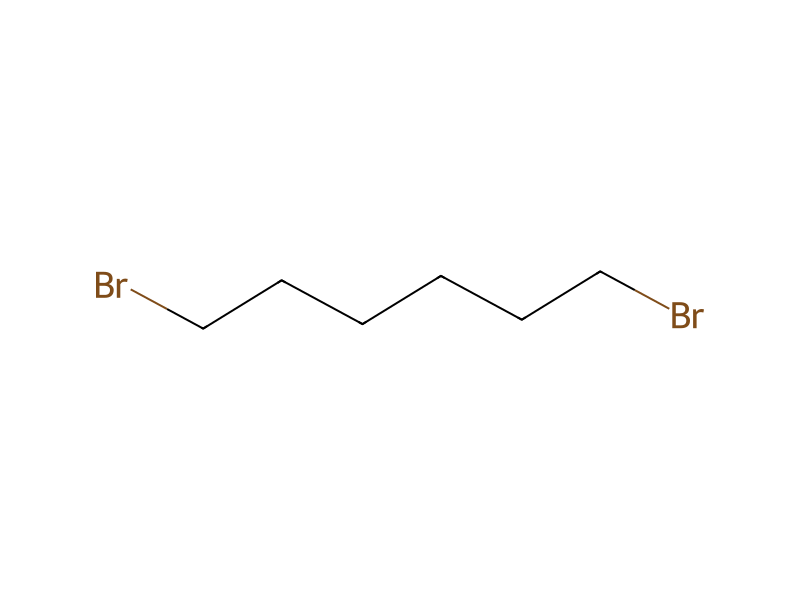
1,6-Dibromohexane → 2,7-Dibromo-9,9-bis(6-bromohexyl)-9H-fluorene
Reaction equation

Br[CH2:2][CH2:3][CH2:4][CH2:5][CH2:6][CH2:7][Br:8].[Br:9][C:10]1[CH:22]=[CH:21][C:20]2[C:19]3[C:14](=[CH:15][C:16]([Br:23])=[CH:17][CH:18]=3)[CH2:13][C:12]=2[CH:11]=1>[Br-].C([N+](CCCC)(CCCC)CCCC)CCC.[OH-].[K+]>[Br:9][C:10]1[CH:22]=[CH:21][C:20]2[C:19]3[C:14](=[CH:15][C:16]([Br:23])=[CH:17][CH:18]=3)[C:13]([CH2:2][CH2:3][CH2:4][CH2:5][CH2:6][CH2:7][Br:8])([CH2:2][CH2:3][CH2:4][CH2:5][CH2:6][CH2:7][Br:8])[C:12]=2[CH:11]=1Participants
Reactant 2

Product 1

Reagents, catalysts & solvents 2


Procedure
To a mixture of tetrabutylammonium bromide (300 mg, 9.3 mmol), aqueous potassium hydroxide (100 mL, 50%) and 1,6-dibromohexane (22.6 g, 92.6 mmol) was added 2,7-dibromofluorene at 75° C. After 15 minutes, the mixture was cooled down to room temperature, and extracted with CH2Cl2. The organic layer was washed with water, aqueous HCl, water and brine, dried over MgSO4, and then concentrated. Unreacted 1,6-dibromohexane was distilled off. The residue was purified by silica gel column chromatography (Hexane:CHCl3=9:1) and recrystallized from ethanol to give 2 (4.8 g, 80%) as a white solid. 1H NMR (200 MHz, CDCl3): δ 7.2–7.4 (m, 6H), 3.12 (t, 4H), 1.75 (t, 4H), 1.5 (m, 4H), 1.0 (m, 8H), 0.4 (m, 4H). 13C NMR (50 MHz, CDCl3): δ 152.3, 139.2, 130.5, 126.2, 121.7, 121.4, 55.7, 40.2, 34.1, 32.8, 29.1, 27.9, 23.6.
Workup
- extractionextracted with CH2Cl2
- washThe organic layer was washed with water, aqueous HCl, water and brine
- dry with materialdried over MgSO4
- concentrationconcentrated
- distillationUnreacted 1,6-dibromohexane was distilled off
- customThe residue was purified by silica gel column chromatography (Hexane:CHCl3=9:1)
- customrecrystallized from ethanol
Sources & evidence
- ORD record
- ord-d8fefa1c433247eeab68944dfe570952
- Source dataset
- uspto-grants-2006_12
- Patent number
- US07144950B2
Reaction notes
Loading…