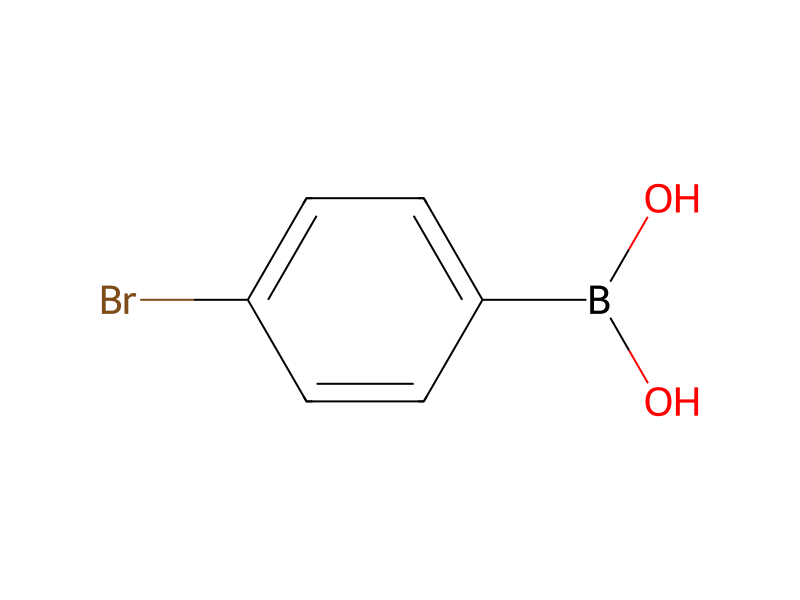
(4-Bromophenyl)boronic acid → 4-(4-Bromo-phenyl)-3,5-dimethyl-isoxazole
Reaction equation

[Br:1][C:2]1[CH:7]=[CH:6][C:5](B(O)O)=[CH:4][CH:3]=1.[CH3:11][C:12]1[C:16](I)=[C:15]([CH3:18])[O:14][N:13]=1.C([O-])(O)=O.[Na+]>COCCOC.O.Cl[Pd](Cl)([P](C1C=CC=CC=1)(C1C=CC=CC=1)C1C=CC=CC=1)[P](C1C=CC=CC=1)(C1C=CC=CC=1)C1C=CC=CC=1>[Br:1][C:2]1[CH:7]=[CH:6][C:5]([C:16]2[C:12]([CH3:11])=[N:13][O:14][C:15]=2[CH3:18])=[CH:4][CH:3]=1Participants
7
Reactant 3


Product 1

Reagents, catalysts & solvents 3



Conditions
- Temperature
- 80 °C
Procedure
A mixture of 4-bromophenylboronic acid (1 g, 5 mmol), 3,5-dimethyl-4-iodoisoxazole (0.93 g, 4.2 mmol), bis(triphenylphospine)palladium(II) chloride (59 mg, 2 mol %), NaHCO3 (1.06 g, 12.6 mmol) in DME (5 mL) and H2O (5 mL) was heated to 80° C. under N2 for 18 h. The reaction mixture was partitioned between 1 N HCl and EtOAc. The organic layer was washed with saturated NaHCO3, brine, dried over Na2SO4 and concentrated. The residue was purified by silica gel chromatography (5% EtOAc in hexanes) to give the title compound as a white solid (0.9 g, 86%).
Workup
- customThe reaction mixture was partitioned between 1 N HCl and EtOAc
- washThe organic layer was washed with saturated NaHCO3, brine
- dry with materialdried over Na2SO4
- concentrationconcentrated
- customThe residue was purified by silica gel chromatography (5% EtOAc in hexanes)
Sources & evidence
- ORD record
- ord-d3f30fc64a47480d858c810e9141ac7f
- Source dataset
- uspto-grants-2006_12
- Patent number
- US07148226B2
Reaction notes
Loading…