Diisopropylethylamine → HCID 58764141, compound
Reaction equation

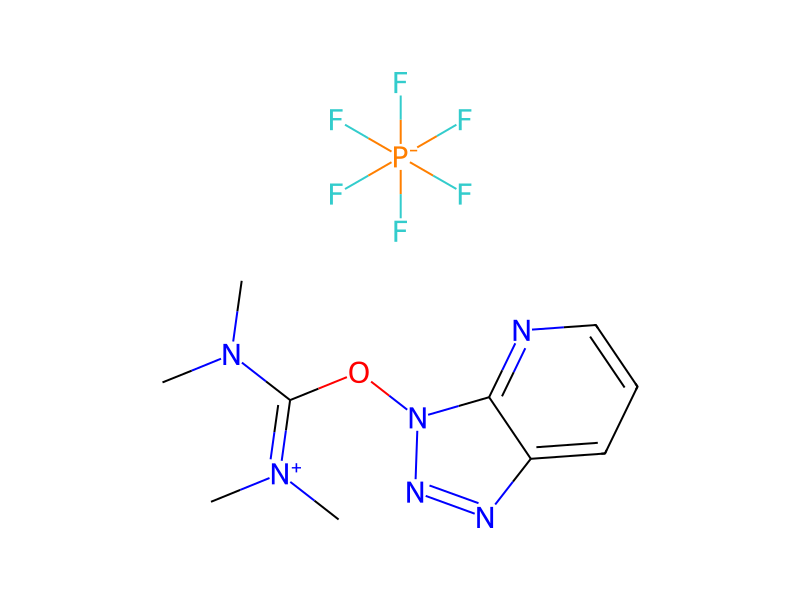
[Br:1][C:2]1[CH:10]=[CH:9][C:5]([C:6]([OH:8])=O)=[C:4]([CH2:11][CH3:12])[CH:3]=1.[CH:13]([N:16](C(C)C)CC)(C)[CH3:14].F[P-](F)(F)(F)(F)F.N1(OC(N(C)C)=[N+](C)C)C2N=CC=CC=2N=N1>ClCCl.CN(C)C=O>[Br:1][C:2]1[CH:10]=[CH:9][C:5]([C:6]2[O:8][CH:14]=[CH:13][N:16]=2)=[C:4]([CH2:11][CH3:12])[CH:3]=1Participants
Reactant 3


Product 1

Reagents, catalysts & solvents 1

Conditions
- Temperature
- 135 °C
Procedure
4-Bromo-2-ethyl-benzoic acid (6.8 g, 30 mmol), diisopropylethylamine (7.8 mL, 44.7 mmol), O-(7-azabenzotriazol-1-yl)-N,N,N′,N′-tetramethyluronium hexafluorophosphate (HATU, 14 g, 37 mmol), and aminoacetaldehyde dimethyl ether (4 mL, 37 mmol) in 2:1 dichlormethane/dimethylformamide (120 mL) 5 h at room temperature. The solution was washed with several portions of water, then 1N HCl(aq) and saturated sodium chloride, dried (Na2SO4), filtered, and concentrated in vacuo to a crude light yellow oil. The residue was redissolved in Eaton's reagent (P2O5 in methanesulfonic acid, 100 mL), and the solution was heated at 135° C. under argon for 6 h. The solution was cooled to room temperature and carefully poured onto ice. The mixture was extracted with dichloromethane, and the organic layer was backwashed with saturated sodium chloride, dried (Na2SO4), filtered, and concentrated in vacuo to a crude oil. The residue was redissolved in ethyl acetate and washed with saturated sodium bicarbonate, then saturated sodium chloride, dried (Na2SO4), filtered, and concentrated in vacuo to pure brown liquid (3.16 g, 44%), 1H NMR (300 MHz, CDCl3): δ ppm 1.24 (t, J=7.54 Hz, 3 H) 3.09 (q, J=7.54 Hz, 2 H) 7.27 (s, 1 H) 7.42 (dd, J=8.38, 1.98 Hz, 1 H) 7.48 (d, J=2.07 Hz, 1 H) 7.74 (s, 1 H) 7.81 (d, J=8.48 Hz, 1 H).
Workup
- customat room temperature
- washThe solution was washed with several portions of water
- dry with material1N HCl(aq) and saturated sodium chloride, dried (Na2SO4)
- filtrationfiltered
- concentrationconcentrated in vacuo to a crude light yellow oil
- dissolutionThe residue was redissolved in Eaton's reagent (P2O5 in methanesulfonic acid, 100 mL)
- temperatureThe solution was cooled to room temperature
- additioncarefully poured onto ice
- extractionThe mixture was extracted with dichloromethane
- dry with materialdried (Na2SO4)
- filtrationfiltered
- concentrationconcentrated in vacuo to a crude oil
- dissolutionThe residue was redissolved in ethyl acetate
- washwashed with saturated sodium bicarbonate
- dry with materialsaturated sodium chloride, dried (Na2SO4)
- filtrationfiltered
- concentrationconcentrated in vacuo to pure brown liquid (3.16 g, 44%), 1H NMR (300 MHz, CDCl3): δ ppm 1.24 (t, J=7.54 Hz, 3 H) 3.09 (q, J=7.54 Hz, 2 H) 7.27 (s, 1 H) 7.42 (dd, J=8.38, 1.98 Hz, 1 H) 7.48 (d, J=2.07 Hz, 1 H) 7.74 (s, 1 H) 7.81 (d, J=8.48 Hz, 1 H)
Sources & evidence
- ORD record
- ord-458d335390b843b481da540fbd871d4e
- Source dataset
- uspto-grants-2006_12
- Patent number
- US07151105B2
Reaction notes
Loading…