Triethylamine → 1,1-Dimethylethyl 4-(4-morpholinylcarbonyl)-1-piperazinecarboxylate
Reaction equation

[C:1]([O:5][C:6]([N:8]1[CH2:13][CH2:12][NH:11][CH2:10][CH2:9]1)=[O:7])([CH3:4])([CH3:3])[CH3:2].C([N:16]([CH2:19]C)CC)C.[CH2:21]1[CH2:25][O:24][CH2:23][CH2:22]1.[OH2:26]>CCOCC>[C:1]([O:5][C:6]([N:8]1[CH2:13][CH2:12][N:11]([C:19]([N:16]2[CH2:21][CH2:25][O:24][CH2:23][CH2:22]2)=[O:26])[CH2:10][CH2:9]1)=[O:7])([CH3:4])([CH3:2])[CH3:3]Participants


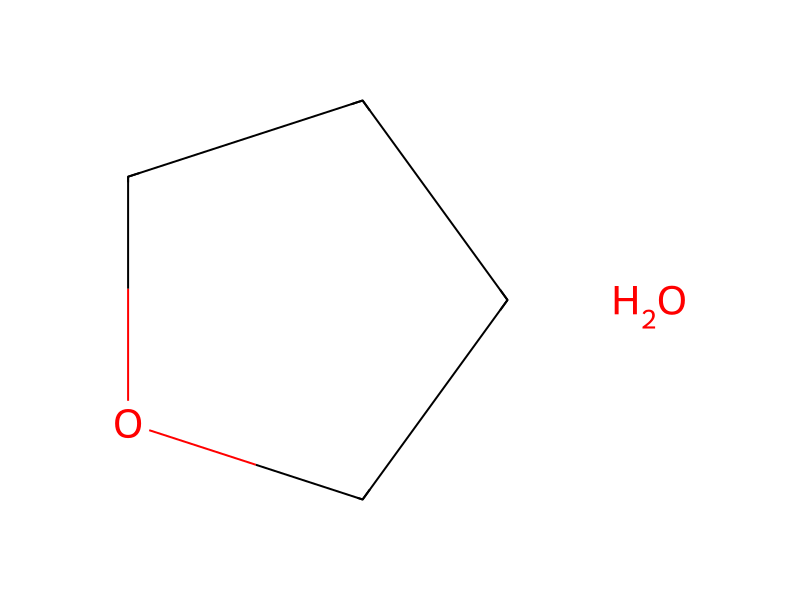


Conditions
- Temperature
- 0 °C
Procedure
N-tert-butyloxycarbonylpiperazine (1.0 g, 5.34 mmol) was dissolved in 5 mL of THF: water (1: 1) and cooled in an ice bath. Triethylamine (1.45 mL, 10.68 mmol), followed by 4-morpholinocarbonyl chloride (0.752 mL, 6.4 mmol) in 5 mL of ether were added, and stirred at 0° C. for 1 hour and at room temperature for 2 hours. Solvents were removed and 40 mL of ethyl acetate was added to the residue. The ethyl acetate layer was washed with brine (30 mL x 3) and dried over anhydrous sodium sulfate. After filtered, the filtrate was concentrated in vacuo to yield 1.39 g of N-tert-butyloxycarbonyl-N'-morpholinocarbonyl-piperazine in 87% yield as a solid. MS m/z M+H=300, M+NH4 =317; H1 -NMR (in CDCl3) δ=1.49 (s, 9H, Boc), 3.25 (m, 8H, 4×CH2), 3.52 (m, 4H), 3.65 (m, 4H). The obtained N-tert-butyloxycarbonyl-N'-morpholinocarbonyl-piperazine (1.38 g, 4.62 mmol) was dissolved in 10 mL of 20% trifluoroacetic acid in methylene chloride and stirred at room temperature for 1 hour. Solvent and trifluoro acetic acid were removed to obtain N-morpholinocarbonylpiperazine trifluoroacetic acid salt in quantitative yield. MS m/z M+H=200, H1 -NMR (in MeOH-d4) δ=3.22 (m, 4H), 3.3 (m, 4H), 3.45 (m, 4H), 3.65 (m, 4H). The obtained N-morpholinocarbonylpiperazine trifluoroacetic acid salt is dissolved in 30 mL of acetonitrile and cooled in an ice bath. Solid sodium bicarbonate is added to the acetonitrile solution and stirred for an additional 2 hours. Solid is filtered off and the filtrate is concentrated in vacuo to yield N-morpholinocarbonylpiperazine. Following the procedure of Example 6, but replacing 1-benzylpiperazine with 1-morpholinocarbonylpiperazine, provides the desired compound. The product of Example 3 (2.1 g, 2.03 mmol), 1-morpholinocarbonylpiperazine (1.212 g, 6.09 mmol), and triethylamine (0.85 mL, 6.09 mmol) in 10 mL of methylene chloride are used. The obtained product (I.0 g) is treated with 48%-HF (4 mL) in 35 mL of acetonitrile in the procedure described in Example 5 to yield the pure title compound.
Workup
- temperaturecooled in an ice bath
- additionwere added
- customSolvents were removed
- addition40 mL of ethyl acetate was added to the residue
- washThe ethyl acetate layer was washed with brine (30 mL x 3)
- dry with materialdried over anhydrous sodium sulfate
- filtrationAfter filtered
- concentrationthe filtrate was concentrated in vacuo
Sources & evidence
- ORD record
- ord-f4ed1a162a3a422cb933b879722bf34c
- Source dataset
- uspto-grants-1996_10
- Patent number
- US05561140
Reaction notes
Loading…