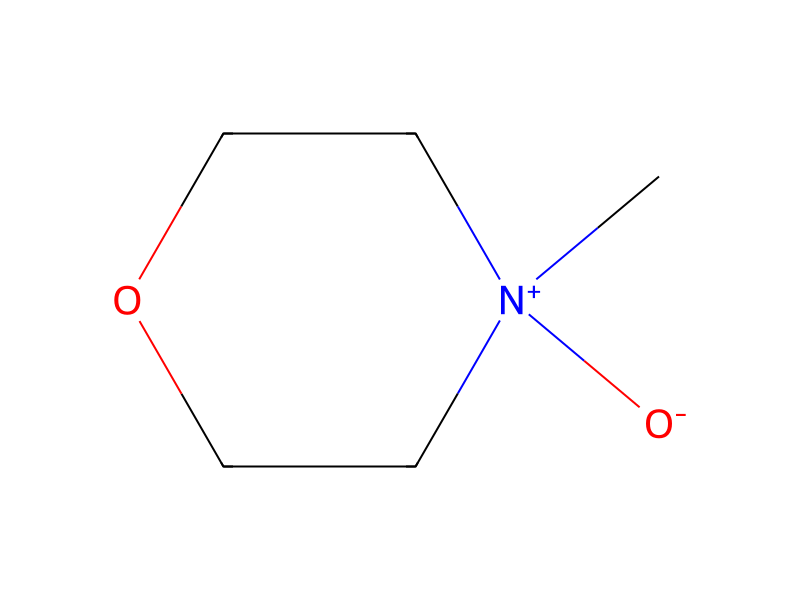
Methyl morpholine oxide → HCID 58359316, compound
Reaction equation

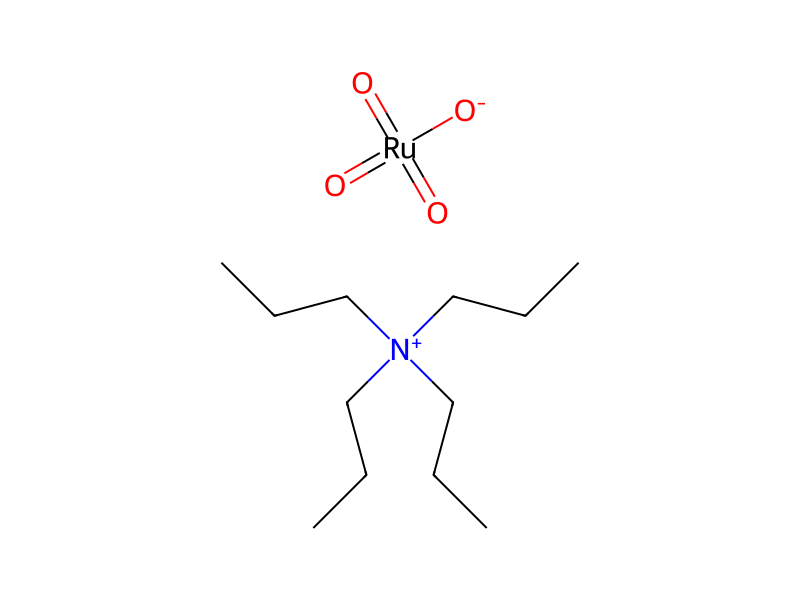
[CH2:1]([Si:3]([CH2:17][CH3:18])([CH2:15][CH3:16])[O:4][C@@H:5]1[C@@H:12]([CH2:13][OH:14])[O:11][CH2:10][CH2:9][C@@:6]21[O:8][CH2:7]2)[CH3:2].C[N+]1([O-])CCOCC1>C(Cl)Cl.[Ru]([O-])(=O)(=O)=O.C([N+](CCC)(CCC)CCC)CC>[CH2:15]([Si:3]([CH2:1][CH3:2])([CH2:17][CH3:18])[O:4][C@@H:5]1[C@@H:12]([CH:13]=[O:14])[O:11][CH2:10][CH2:9][C@@:6]21[O:8][CH2:7]2)[CH3:16]Participants
Reactant 2

Product 1

Reagents, catalysts & solvents 2

Procedure
A stirred suspension of alcohol 34 (15 mg, 0.05 mmol) and 4A° MS (15 mg) in CH2Cl2 (1 mL) at 0° C. was treated sequentially with N-methylmorpholine-N-oxide (9.6 mg, 0.08 mmol) and tetrapropylammonium perruthenate (1.9 mg, 5.47 μmol). After 10 min at 0° C., the resulting suspension was allowed to warm to room temperature and stirred for 30 min by which time TLC showed that all of starting material has been consumed. The suspension was directly loaded onto silica column and eluted with 40% ethyl acetate in hexane to give 7 mg (47%) of 35 as liquid. 1H NMR (400 MHz, CDCl3) δ 9.76 (d, J=0.9 Hz, 1H), 4.16 (ddd, J=11.5, 5.0, 2.7 Hz, 1H), 3.95-3.76 (m, 2H), 3.65 (td, J=11.5, 2.6 Hz, 1H), 3.05 (dd, J=5.3, 1.4 Hz, 1H), 2.59 (d, J=5.4 Hz, 1H), 2.21-2.07 (m, 1H), 1.59 (t, J=2.6 Hz, 1H), 0.98-0.89 (m, 10H), 0.66-0.55 (m, 6H).
Workup
- customhas been consumed
- washeluted with 40% ethyl acetate in hexane
Sources & evidence
- ORD record
- ord-3507edfc7f854c8096e28eae95aefb3f
- Source dataset
- uspto-grants-2015_03
- Patent number
- US08969405B2
Reaction notes
Loading…