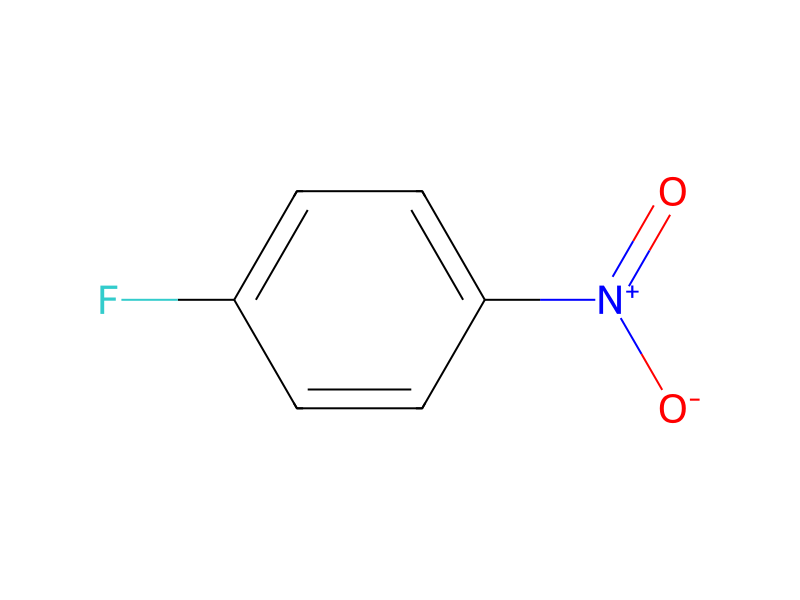
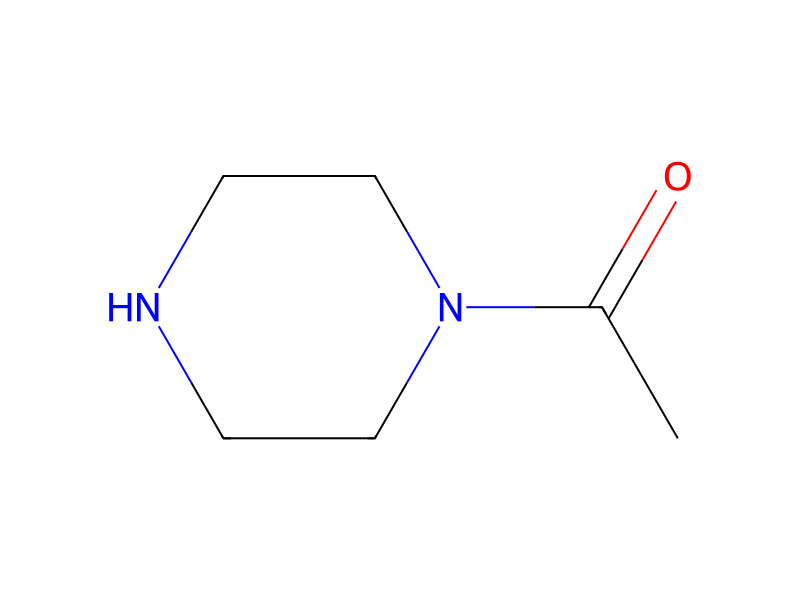
p-Fluoronitrobenzene → 1-Acetyl-4-(4-nitrophenyl)piperazine
Reaction equation

F[C:2]1[CH:7]=[CH:6][C:5]([N+:8]([O-:10])=[O:9])=[CH:4][CH:3]=1.[C:11]([N:14]1[CH2:19][CH2:18][NH:17][CH2:16][CH2:15]1)(=[O:13])[CH3:12]>C(#N)C.O.C(OCC)(=O)C>[N+:8]([C:5]1[CH:6]=[CH:7][C:2]([N:17]2[CH2:18][CH2:19][N:14]([C:11](=[O:13])[CH3:12])[CH2:15][CH2:16]2)=[CH:3][CH:4]=1)([O-:10])=[O:9]Participants
6
Reactant 2
Product 1

Reagents, catalysts & solvents 3



Procedure
A solution of 5.0 g (35.44 mmol) of 1-fluoro-4-nitrobenzene and 4.99 g (38.98 mmol) of N-acetylpiperazine in 50 mL of acetonitrile is heated at 60°C. for 15 hours. The resulting mixture is diluted with water and with ethyl acetate. After separation of the phases by settling and extraction of the aqueous phase with ethyl acetate, the organic phases are combined, dried over Na2SO4, filtered and concentrated under vacuum. 7.7 g of the expected product are obtained in the form of a yellow solid, which is used as obtained in the following step. Yield=88.8%.
Workup
- customAfter separation of the phases
- extractionextraction of the aqueous phase with ethyl acetate
- dry with materialdried over Na2SO4
- filtrationfiltered
- concentrationconcentrated under vacuum
Sources & evidence
- ORD record
- ord-b34b531868a34a4f863d3756b6cf6cba
- Source dataset
- uspto-grants-2015_03
- Patent number
- US08975250B2
Reaction notes
Loading…