Vinyl Acetate → HCID 25158285, compound
Reaction equation
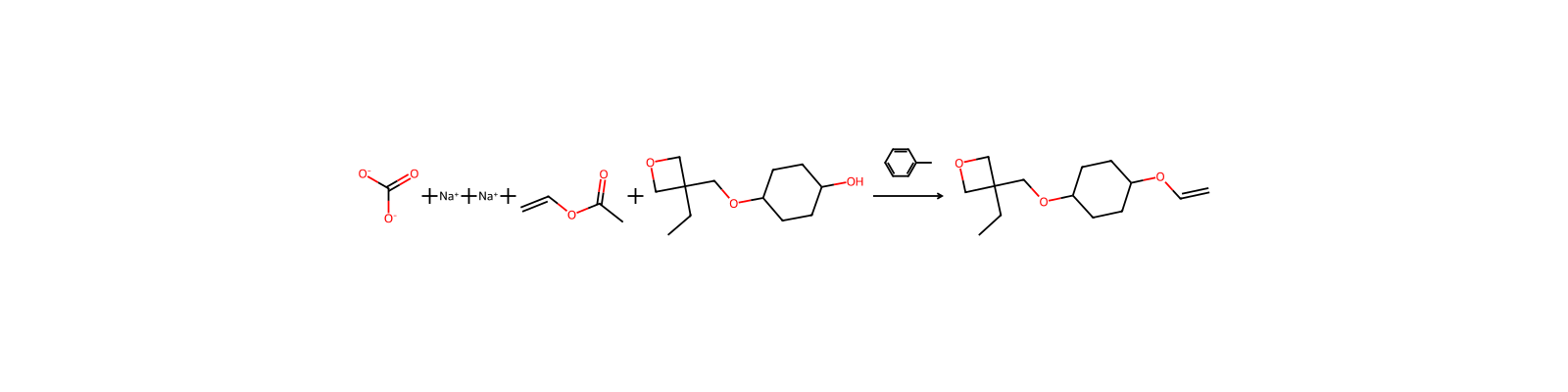
C(=O)([O-])[O-].[Na+].[Na+].[C:7](OC=C)(=O)[CH3:8].[CH2:13]([C:15]1([CH2:19][O:20][CH:21]2[CH2:26][CH2:25][CH:24]([OH:27])[CH2:23][CH2:22]2)[CH2:18][O:17][CH2:16]1)[CH3:14]>C1(C)C=CC=CC=1>[CH2:13]([C:15]1([CH2:19][O:20][CH:21]2[CH2:22][CH2:23][CH:24]([O:27][CH:7]=[CH2:8])[CH2:25][CH2:26]2)[CH2:18][O:17][CH2:16]1)[CH3:14]Participants
Reactant 3



Product 1

Reagents, catalysts & solvents 1

Conditions
- Temperature
- 95 °C
Procedure
Independently, a mixture (100 ml) of sodium carbonate (0.06 mol) with toluene was raised in temperature to 95° C. While maintaining the temperature at 95° C., 4.2 g of vinyl acetate was added dropwise, and 15 minutes later, di-μ-chlorobis(1,5-cyclooctadiene)diiridium(I) [Ir(cod)Cl]2 (0.5 mmol) was added. Next, 4-(3-ethyloxetan-3-yl-methoxy)cyclohexanol (0.05 mol) was added dropwise over 2 hours, followed by performing a reaction in a nitrogen atmosphere while adding 12.6 g of vinyl acetate dropwise and maintaining the reaction temperature at 95° C. After the completion of the dropwise addition and subsequent stirring for 1 hour, the reaction mixture was analyzed by gas chromatography and found that there was formed 3-ethyl-3-(4-vinyloxycyclohexyloxymethyl)oxetane represented by following formula in a yield of 92%. This was subjected to a 1H-NMR (CDCl3) measurement and found that signals specific to vinyl group were observed at 6.5 ppm, 4.2 ppm, and 4.04 ppm, as in Synthesis Example 1.
Workup
- customa reaction in a nitrogen atmosphere
- temperaturemaintaining the reaction temperature at 95° C
- additionAfter the completion of the dropwise addition
Sources & evidence
- ORD record
- ord-92757a1f5b784a2498af2f2c803c581b
- Source dataset
- uspto-grants-2015_03
- Patent number
- US08975349B2
Reaction notes
Loading…