Hydrochloric Acid → HCID 13089616, compound
Reaction equation

[CH:1]1[C:6]2[CH2:7][C@H:8]3[N:13]([CH2:14][CH:15]4[CH2:17][CH2:16]4)[CH2:12][CH2:11][C@:10]45[C@H:18]([C:20]([CH2:22][CH2:23][C@@:9]34[OH:24])=O)[O:19][C:4]([C:5]=25)=[C:3]([OH:25])[CH:2]=1.C([NH2:33])C1C=CC=CC=1.[BH4-].[Na+].Cl>>[CH2:22]1[C@H:20]([NH2:33])[C@@H:18]2[O:19][C:4]3=[C:3]([OH:25])[CH:2]=[CH:1][C:6]4=[C:5]3[C@:10]32[CH2:11][CH2:12][N:13]([CH2:14][CH:15]2[CH2:16][CH2:17]2)[C@H:8]([CH2:7]4)[C@:9]3([OH:24])[CH2:23]1Participants


Procedure
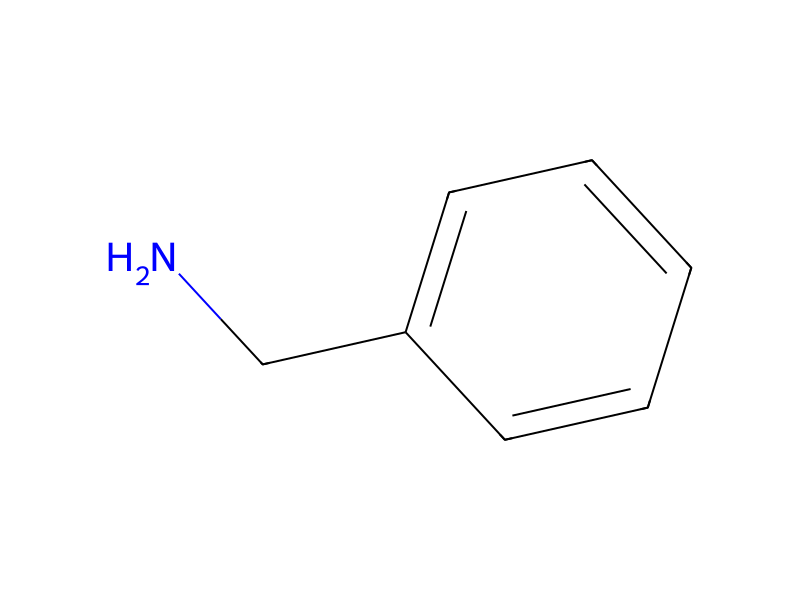
Chemistry. The synthesis of the newly designed NAQ analogues was achieved readily (FIG. 21, Table 8).34-38 Briefly, naltrexone underwent reductive amination with benzylamine and sodium borohydride, followed by catalytic hydrogenation in the presence of the concentrated hydrochloric acid to yield 6α-naltrexamine dihydrocholoride (6α-NTA.2HCl)39 in a total yield of 79%. A variety of substituted isoquinoline-3-carboxylic acids or its saturated counterparts (see Supporting Information) were then coupled to 6α-NTA.2HCl using EDCI/HOBt. After treating the coupling mixture with K2CO3 in methanol, the NAQ analogues were then obtained by silica gel column purification in yields ranging from 29% to 89%. Biology. In Vitro and In Vivo Pharmacological Studies. The newly synthesized NAQ analogues were first evaluated in the radioligand competition binding assay and the MOR [35S]GTPγS functional assay on OR-transfected Chinese hamster ovarian (CHO) cell membranes for their binding affinity, selectivity and MOR agonism/antagonism in vitro. They were further tested in the behavioral tail immersion assay for their functional activity in vivo. The KOR and the DOR [35S]GTPγS functional assays (in vitro) were also conducted for two selected compounds, 4 and 11. Compound 11, showing antagonism in the tail immersion assay, was then examined in the opioid withdrawal assays (in vivo). Naltrexone (NTX) was also tested as a control in all the assays. In Vitro Radioligand Binding Assay and the MOR [35S]GTPγS Functional Assay. The competitive radioligand binding assay was performed on monoclonal OR-expressed CHO cell membranes as described previously.22,29,34-38 [3H]Naloxone (NLX), [3H]naltrindole (NTI), and [3H]diprenorphine (DPN) were used to label the MOR, the DOR and the KOR, respectively. The MOR [35S]GTPγS binding assay was conducted to determine the Gi/o agonism/antagonism of each new ligand at the MOR as described previously.22,29,34-38 The results were interpreted as potency (EC50) and the relative efficacy (% Emax) of each compound to the MOR full agonist DAMGO for MOR activation. As seen in Table 8, all sixteen NAQ analogues retained sub-nanomolar to nanomolar binding affinity at the MOR.
Workup
- customThe synthesis of the newly designed NAQ analogues
Sources & evidence
- ORD record
- ord-85c6d717315341eb866e0a900e7ca4af
- Source dataset
- uspto-grants-2015_03
- Patent number
- US08980908B2
Reaction notes
Loading…